
BPC-157 for Rotator Cuff Injuries: Evidence and Reported Doses
Research context reviewed 20 October 2026
BPC-157 has direct rotator cuff research in rats, and a human study after cuff repair is now registered. Neither establishes a proven treatment for a torn human rotator cuff. The rat findings concern tendon healing and shoulder function; the human trial had no results and was not yet recruiting when checked on 20 October 2026.
The direct shoulder finding is a rat conference abstract. A small rat Achilles experiment offers a separate BPC-157/TB-500 comparison, and the registered human trial concerns recovery after surgical repair. Those three evidence levels answer different questions; none yet establishes fewer human cuff re-tears or that surgery becomes unnecessary.
Here is what has actually been investigated, which benefits were measured and where the dose figures come from.
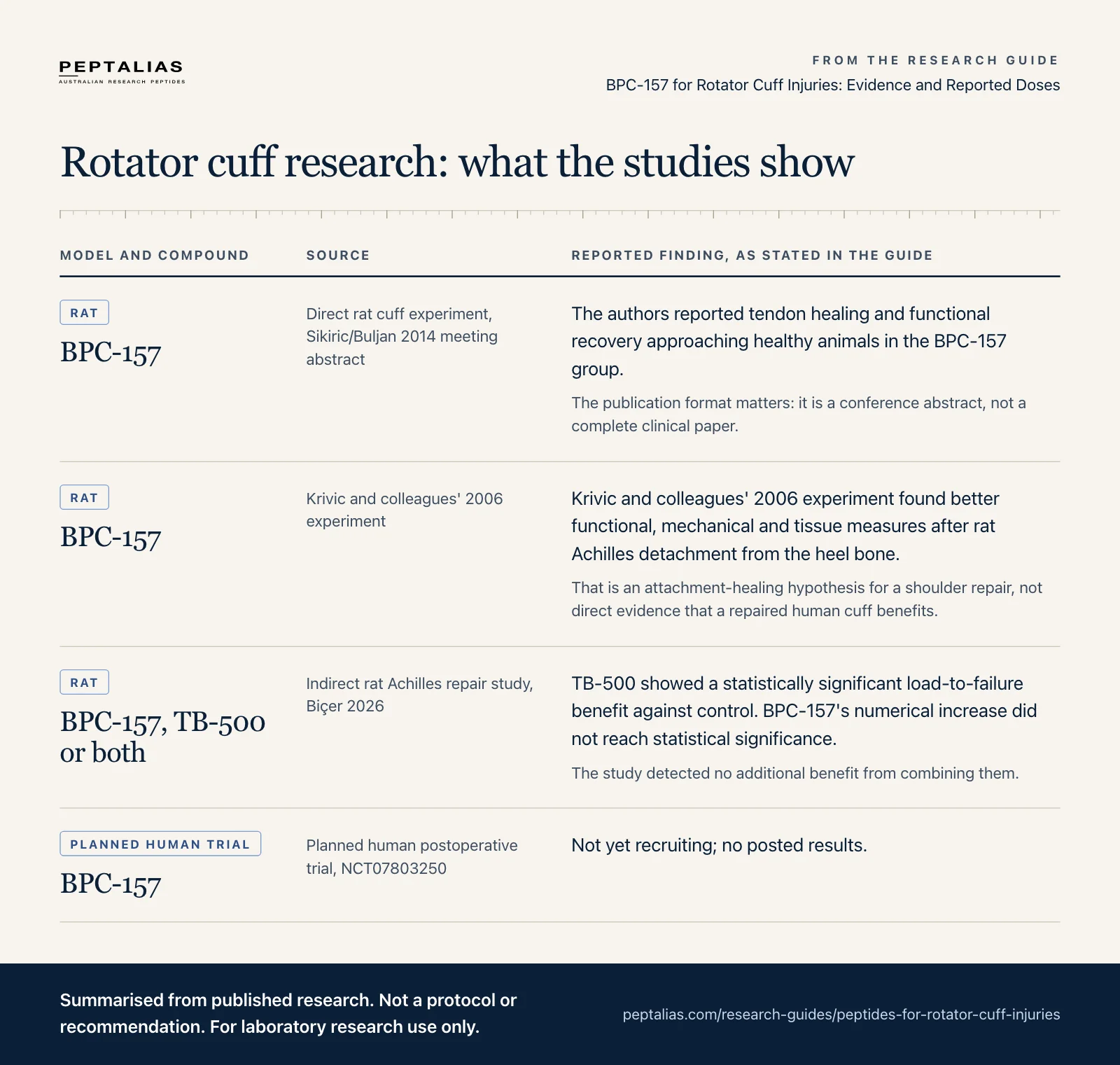
| Model | Compound | Source | Reported finding |
|---|---|---|---|
| Rat | BPC-157 | Direct rat cuff experiment, Sikiric/Buljan 2014 meeting abstract | The authors reported tendon healing and functional recovery approaching healthy animals in the BPC-157 group. The publication format matters: it is a conference abstract, not a complete clinical paper. |
| Rat | BPC-157 | Krivic and colleagues' 2006 experiment | Krivic and colleagues' 2006 experiment found better functional, mechanical and tissue measures after rat Achilles detachment from the heel bone. That is an attachment-healing hypothesis for a shoulder repair, not direct evidence that a repaired human cuff benefits. |
| Rat | BPC-157, TB-500 or both | Indirect rat Achilles repair study, Biçer 2026 | TB-500 showed a statistically significant load-to-failure benefit against control. BPC-157's numerical increase did not reach statistical significance. The study detected no additional benefit from combining them. |
| Planned human trial | BPC-157 | Planned human postoperative trial, NCT07803250 | Not yet recruiting; no posted results. |
Tendon pain, partial tear or repair after surgery?
The rotator cuff is a group of muscles and tendons that helps lift and rotate the arm and stabilise the shoulder. Its tendons attach to the upper arm bone. A painful tendon, a tear through part of its thickness and a tendon detached across its full thickness are different problems. Repair surgery creates another question: how well does the tendon heal back to bone?
AAOS's rotator cuff guide explains tear types and treatment decisions. It also notes that some tears are painless and that nonsurgical care can improve symptoms and function. Those facts matter when interpreting a claim that someone's shoulder “healed”.
| Shoulder situation | What the reader wants | What would count as evidence of that benefit? |
|---|---|---|
| Tendon pain or tendinopathy | Better sleep, less pain and easier lifting | Pain and function scores compared with an appropriate control, accounting for rehabilitation. |
| Partial-thickness tear | Better function and prevention of progression | Clinical assessment plus relevant imaging where structural change is claimed. |
| Full-thickness tear | Useful strength and a decision about repair | Tear size, retraction, function and clinical review; feeling better alone does not show reattachment. |
| Recovery after repair | An intact repair, regained strength and fewer re-tears | Postoperative integrity assessment and function, with a comparison group and adequate follow-up. |
This separates three outcomes often blended into one testimonial: less pain, more movement and a stronger healed tendon. Each is worth measuring. One does not automatically prove the others.
What did the direct BPC-157 shoulder experiment show?
In a 2014 FASEB meeting abstract, Sikiric, Buljan and colleagues described 48 rats with detachment of the supraspinatus and infraspinatus tendons, two parts of the cuff. Rats were assigned to BPC-157 or saline treatment, with assessments at 2, 4, 8 and 12 weeks.
The authors reported tendon healing and functional recovery approaching healthy animals in the BPC-157 group. Their listed measures included movement range, walking pattern and front-limb muscle strength. This gives BPC-157 a shoulder-specific research basis rather than relying entirely on an Achilles study.
The publication format matters: it is a conference abstract, not a complete clinical paper. It provides little detail for independently judging the magnitude and reliability of the result. It does not establish a human dose, a re-tear reduction or a safe return to overhead training.
Broader BPC tendon-to-bone research is relevant too. Krivic and colleagues' 2006 experiment found better functional, mechanical and tissue measures after rat Achilles detachment from the heel bone. That is an attachment-healing hypothesis for a shoulder repair, not direct evidence that a repaired human cuff benefits.
Is there a human rotator cuff trial?
It addresses postoperative recovery. Even a positive future result in that population would need careful interpretation before being applied to avoiding surgery for an untreated full-thickness tear.
Does adding TB-500 make Wolverine better?
Wolverine usually names a BPC-157 and TB-500 pairing. PEPTALIAS's listed formula is 5 mg BPC-157 plus 5 mg TB-500, totalling 10 mg. Those are nominal vial contents, not a dose. The theory is that combining tissue-repair effects could provide more benefit than either component alone. That theory needs a combination experiment.
A 2026 study by Biçer and colleagues tested that assumption in another tendon. Thirty-two rats underwent Achilles transection and repair, with eight assigned to each of four arms: control, BPC-157, TB-500 or both. Each arm then contributed only four tendons to mechanical testing; the other four were used for tissue analysis.
At about four weeks, TB-500 showed a statistically significant load-to-failure benefit against control. BPC-157's numerical increase did not reach statistical significance. With only four mechanical samples per arm, that finding also cannot establish that BPC-157 has no benefit. The study detected no additional benefit from combining them. That does not prove the treatments equivalent, especially with four mechanical samples per arm. It does mean this experiment supplies no support for declaring Wolverine automatically stronger.
There is also an identity question. Full-length thymosin beta-4, or Tβ4, and material sold as TB-500 are not names that can safely be treated as interchangeable. An analytical study by Esposito and colleagues identified an acetylated seven-amino-acid fragment in the TB-500 material it analysed. That finding cannot identify every supplier's product.
Read the TB-500 versus thymosin beta-4 guide before attributing a full-length Tβ4 result to a vial labelled TB-500. The 2026 study's own material should also not be assumed identical to a different supplier's vial.
Where does KLOW fit?
KLOW contains BPC-157, TB-500, GHK-Cu and KPV. In the PEPTALIAS listing the nominal amounts are 10 mg, 10 mg, 50 mg and 10 mg respectively, totalling 80 mg.
| Option | Proposed research interest | What remains unproven for a rotator cuff injury |
|---|---|---|
| BPC-157 | Tendon repair and functional recovery, including the direct rat cuff abstract | A human structural-healing benefit, an effective shoulder dose and reduced re-tear rate. |
| TB-500 | Tissue remodelling research; exact identity must be checked | A benefit for the exact retail material in human cuff tears. |
| Wolverine | A fixed BPC-157 5 mg/TB-500 5 mg combination | That adding TB-500 improves human shoulder outcomes over BPC alone. |
| KLOW | Adds GHK-Cu connective-tissue and KPV inflammatory-signalling research interests | That the four-component formula heals cuff tears or outperforms a simpler preparation. |
GHK-Cu has been studied in rat connective-tissue wounds and rat ACL reconstruction. The ACL study found transient improvements in knee laxity and, at the lower tested concentration, graft stiffness at six weeks, without a significant ultimate-load benefit. These are distinct experiments, not cuff trials. KPV's cell and mouse-colitis research concerns inflammatory signalling in another tissue context.
Those findings explain the ingredient research, rather than validating the complete KLOW formula for a shoulder injury. The KLOW composition guide and Wolverine versus separate-vial comparison help with ingredient and format questions.
What amounts and schedules are actually reported?
There is no validated human BPC-157, Wolverine or KLOW dosing protocol for a rotator cuff tear in the evidence reviewed here. Published quantities still deserve a clear answer.
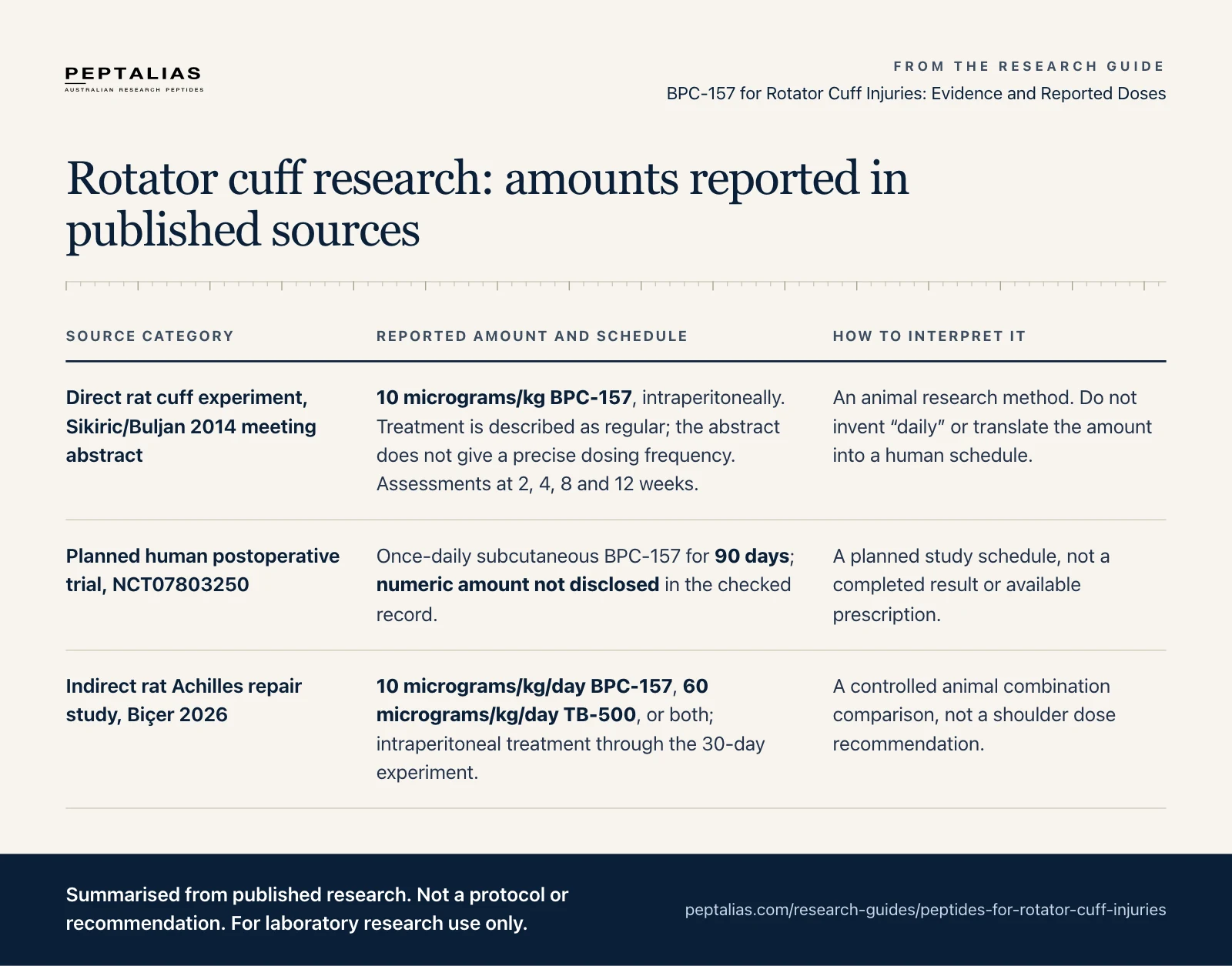
| Source category | Reported amount and schedule | How to interpret it |
|---|---|---|
| Direct rat cuff experiment, Sikiric/Buljan 2014 meeting abstract | 10 micrograms/kg BPC-157, intraperitoneally. Treatment is described as regular; the abstract does not give a precise dosing frequency. Assessments at 2, 4, 8 and 12 weeks. | An animal research method. Do not invent “daily” or translate the amount into a human schedule. |
| Planned human postoperative trial, NCT07803250 | Once-daily subcutaneous BPC-157 for 90 days; numeric amount not disclosed in the checked record. | A planned study schedule, not a completed result or available prescription. |
| Indirect rat Achilles repair study, Biçer 2026 | 10 micrograms/kg/day BPC-157, 60 micrograms/kg/day TB-500, or both; intraperitoneal treatment through the 30-day experiment. | A controlled animal combination comparison, not a shoulder dose recommendation. |
| Named clinic publication, LifeMed January 2020 catalogue, BPC page | 300 micrograms subcutaneously nightly for 30 days; separate 500-microgram oral capsule daily for 30 days. | Published clinic conventions. The page does not provide a human cuff trial validating either. |
A clinic chart can tell you what its publisher lists. It cannot prove that the schedule repairs a tear. Likewise, 500 micrograms and 500 milligrams differ by 1,000 times. Unclear forum units are a reason to check the original source, not silently correct them into a reliable protocol.
Common shoulder questions
Can peptides help me avoid rotator cuff surgery?
No evidence reviewed here establishes that these peptides make repair unnecessary. Some people improve with nonsurgical care, which itself prevents attributing a better shoulder to a peptide alone. The decision depends on the actual tear, weakness, progression and activity goals assessed with the treating clinician.
Does less pain mean a partial tear has healed?
No. Pain relief is useful, but it is not an image of the tendon or a strength test. If a claim is specifically that the tear closed, ask what baseline and follow-up evidence showed that change.
Must BPC-157 be injected next to the shoulder?
The evidence above does not establish that local subcutaneous administration works better. The direct cuff abstract used intraperitoneal delivery in rats; the human trial has no results. Neither supports a claim that proximity to the painful shoulder is required.
Does a product report establish the same material as the study?
Only if identity and sample linkage are demonstrated. The PEPTALIAS-linked BPC-157, TB-500, Wolverine and KLOW reports inspected on 20 October 2026 describe themselves as reference templates. They do not establish current-stock linkage, sterility or effectiveness. The laboratory-report guide explains what to check before interpreting a reported result.
Follow the shoulder evidence, then check the material
For the broader compound research, start with what BPC-157 is. Researchers comparing materials can then inspect the BPC-157 product details alongside the relevant identity and blend guides. The right comparison is the exact molecule, the actual experiment and the outcome it measured.
PEPTALIAS materials are supplied for laboratory research, not human or veterinary use. This article explains published research and reported quantities; it does not provide a personal treatment plan.