
BPC-157 Dosage: Human Study Amounts, Routes and Published Protocols Compared
Research context reviewed 20 October 2026
BPC-157 has no single established human dosage. Published human reports have used very different amounts and routes: milligrams injected into a knee joint, a bladder-wall procedure, and two days of intravenous infusion. Older rectal studies exist mainly as conference abstracts. A registered oral-tablet study has no posted results.
Those numbers should not be compressed into one “normal dose”. They describe different formulations, tissues and research questions. Daily microgram schedules in clinic guides belong to a separate category from the amounts used in published human investigations.
This guide puts the source beside each figure, explains the oral-versus-injection question and separates quantity arithmetic from a regimen. Evidence and registry status were checked on 20 October 2026.
Contents: Human study amounts · Oral versus injection · Published clinic protocols · Units · Timeline
Human BPC-157 amounts: the source table
| Original report or record | Population and design | Reported amount, route and schedule | What was measured |
|---|---|---|---|
| Lee & Padgett, 2021 | Retrospective knee-pain review: 17 patients identified, 16 contacted; 12 received BPC-157 alone | 4 mg intra-articular (inside the knee joint) for the BPC-only group; combination subgroup received 2–4 mg BPC-157 plus 3–6 mg thymosin beta-4 (TB4). Generally one procedure; two patients had repeat BPC injections after reinjury | Subjective pain and other follow-up questions; no controlled structural-healing endpoint |
| Lee, Walker & Ayadi, 2024 | Uncontrolled pilot in 12 women with interstitial cystitis who had not responded to pentosan polysulfate | 10 mg total, injected around bladder inflammation during one cystoscopy (bladder examination) procedure | Patient-reported symptom response |
| Lee & Burgess, 2025 | Two adults, both previously exposed to intravenous BPC-157 | 10 mg intravenous (IV) on day 1, 20 mg IV on day 2; each in 250 mL saline over one hour; reassessment on day 3 | Selected laboratory markers, vital signs and reported side effects |
| Veljaca et al., 2002/2003; conference abstracts described by FDA | Placebo-controlled phase 1 study: 32 randomised, 24 active | 0.25, 0.5, 1 or 2 mg/kg rectal enema; single dose, one-week washout, then daily for seven days | Tolerability and pharmacokinetic sampling; limited abstract-level reporting |
| Ruenzi et al., 2005; conference abstract described by FDA | Ulcerative colitis: 53 randomised, 46 completed | 80 mg enema once daily for two weeks, versus placebo | Disease Activity Index; limited reporting prevents a firm efficacy conclusion |
| NCT02637284; registry plan, not a published result | Estimated 42 healthy volunteers; phase 1 oral Bepecin/PCO-02 study | Planned single 1, 3 or 6 mg oral doses; repeated 3 mg every eight hours for two weeks | Planned safety/pharmacokinetic evaluation; no posted results |
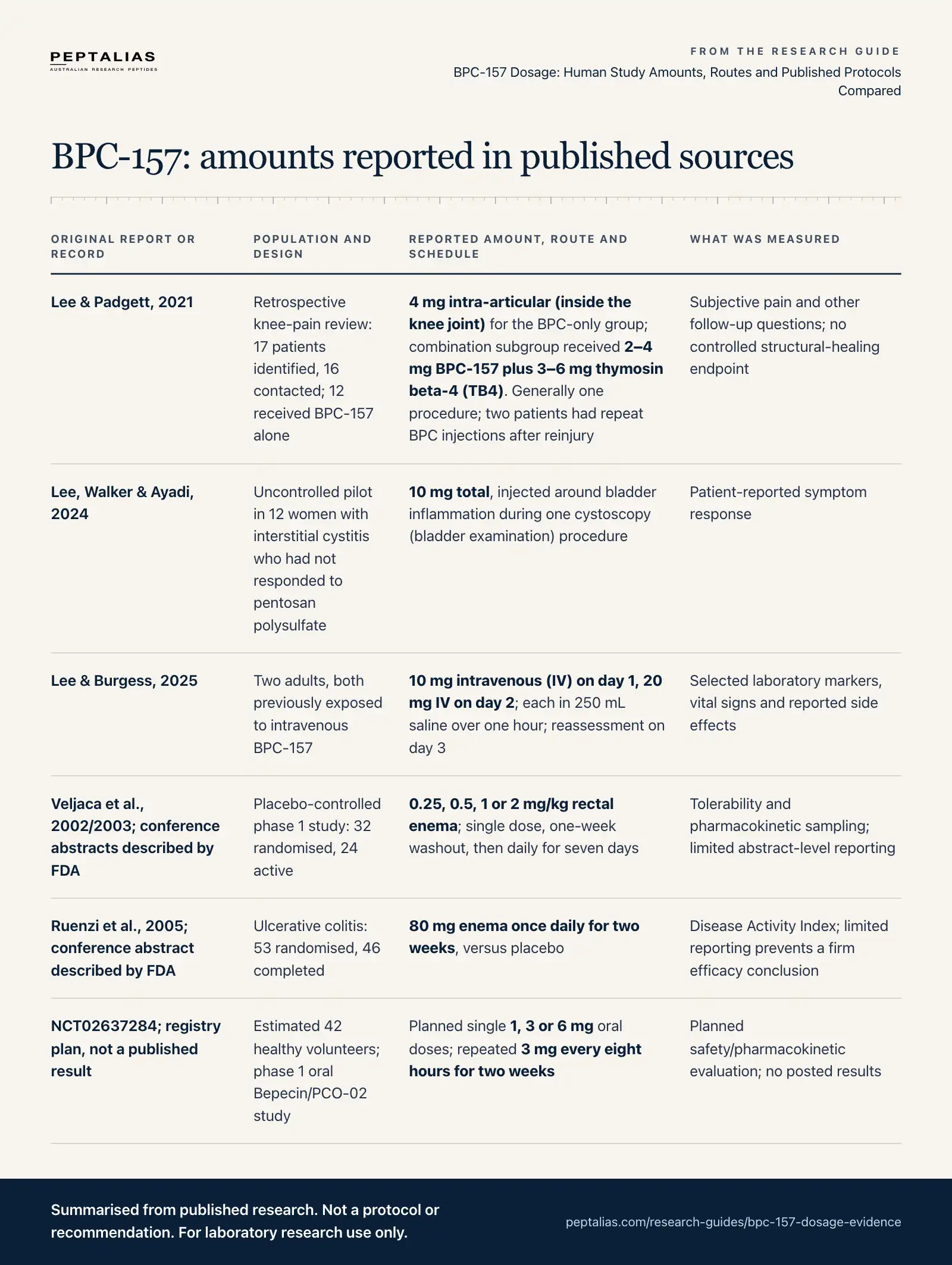
Sources: 2021 knee paper, 2024 cystitis record, 2025 IV record, FDA's 2026 briefing, including older abstracts, oral-trial registry.
The three modern small reports share lead investigator Edwin Lee. They should not be presented as independent multicentre replications.
The older conference work matters: it makes “BPC-157 has never been given to humans” inaccurate. Equally, a conference abstract or an unreported trial cannot support the certainty of a complete, independently assessable clinical report. The table labels that difference.
What did the knee study actually establish?
In the 2021 report, 11 of 12 people receiving BPC-157 alone reported improved knee pain. In the four-person BPC/TB4 subgroup, three reported improvement. The investigators used telephone follow-up with varied intervals and had no placebo group. They did not verify tissue repair with follow-up imaging. Full paper.
The exact BPC-only amount follows from the paper's stated concentration and volume: 2 mL × 2,000 micrograms/mL = 4,000 micrograms = 4 mg. That is a description of the original procedure, not a recommended injection amount.
“Into the knee joint” is a consequential part of the method. It cannot be relabelled as a daily subcutaneous protocol, an oral regimen or evidence that injecting close to an injury is superior. Pain improvement also differs from a repaired ligament, restored tendon strength or a return-to-sport endpoint.
The study included heterogeneous knee complaints. A number from this report does not become an ACL, rotator-cuff or Achilles protocol merely because those structures are involved in musculoskeletal recovery.
The bladder and IV studies answer different questions
The 2024 cystitis pilot reported complete symptom resolution in 10 of 12 participants and an 80% self-rated response in the remaining two. No adverse events were reported. The accessible abstract describes a single 10 mg procedure, not a repeated daily course, and does not supply a defined follow-up duration. It was uncontrolled. Primary report.
The 2025 IV pilot reported no side effects and no measurable change in the selected heart, liver, kidney, thyroid or glucose markers during its brief observation. Its two participants had received IV BPC-157 before enrolment. This is short-term tolerability information from two selected adults; it does not establish a safe upper limit or demonstrate injury healing. Primary report.
These are useful human observations with different purposes. A bladder procedure measures a local disease response. An IV pilot measures short-term monitoring after systemic exposure. Neither determines whether the daily schedules circulated for tendon recovery are effective.
Oral BPC-157 versus injection
No reliable head-to-head human result was identified that establishes oral or injected BPC-157 as the better route. The available reports use different populations and outcomes, so comparing their milligram figures does not answer that question.
The registered oral study, NCT02637284, listed Bepecin, also called PCO-02/BPC-157. It proposed single doses and a repeated-tablet phase. When checked, its status was unknown, with a last known status of active, not recruiting; the record had not been updated since 2015 and contained no posted results. Its estimated enrolment is a plan, rather than a verified treated population.
The route also changes what “exposure” means. A swallowed tablet, a rectal enema, an intra-articular procedure and an IV infusion do not deliver material to the same place in the same way. A mass in milligrams tells us how much was administered, not the concentration reaching the intended tissue.
What about daily subcutaneous injury protocols?
None of the completed human reports summarised here validates a daily subcutaneous (under-the-skin) injury regimen. A registered postoperative rotator-cuff study, NCT07803250, plans once-daily subcutaneous BPC-157 for 90 days after repair in an estimated 30 participants. Its numeric dose is undisclosed. When checked on 20 October 2026, it was not yet recruiting, with no posted results. This is a planned test of that route and setting, not confirmation that a protocol works. The record contains inconsistent comparator descriptions, which also need clarification before interpreting its eventual design.
Why online BPC-157 protocols give different answers
Named clinic guides are useful for understanding where familiar numbers come from. They should keep their source label.
For example, Dr Rogers Centers' guide dated 13 March 2026 gives an opening “typical” range of 200–500 micrograms daily and mentions 2–4-week cycles. Its route table gives 250–500 micrograms for subcutaneous schedules over 4–6 weeks, and 200–500 micrograms for oral/sublingual schedules over 6–8 weeks. Its later injection text describes 250–500 micrograms once or twice daily. Originating clinic guide.
These are that publisher's conventions, not dose-ranging clinical-trial results. The differences within the page are a reason to retain the exact passage and context. Combining them into a new “200–1,000 microgram standard cycle” would create an editorial synthesis that no original experiment tested.
A particular ambiguity is per dose versus per day. A table headed “daily range” and a paragraph describing that amount twice a day can imply different totals. A source should resolve that ambiguity; the reader should not have to guess.
Animal amounts are a separate evidence category
Animal research can test biological activity, routes and timing before human trials. Those methods belong to their species and experimental injury.
For example, Krivic and colleagues' 2006 rat Achilles tendon-to-bone study reported BPC-157 at 10 micrograms/kg, 10 nanograms/kg or 10 picograms/kg, administered intraperitoneally once daily, with assessments through day 21. Its tendon-healing methods do not specify a human daily regimen. Primary study DOI.
A body-weight calculation cannot supply the missing human pharmacology, safety and clinical outcome. The same principle applies when a laboratory concentration appears precise to several decimal places. Precision in the original model is not validation in another population.
This separation also prevents a common timeline error: a study examining tissue at day 21 does not prove that a person should notice symptom improvement on day 21, or that a 21-day course is optimal.
Milligrams, micrograms and total vial quantity
1 milligram equals 1,000 micrograms. The abbreviations mcg and µg both mean micrograms. A nanogram is one-thousandth of a microgram.
| Quantity written one way | The same mass written another way |
|---|---|
| 250 micrograms | 0.25 mg |
| 500 micrograms | 0.5 mg |
| 4 mg | 4,000 micrograms |
| 10 mg | 10,000 micrograms |
These are unit conversions. They do not select a dose. Likewise, a nominal 10 mg vial is not a “10 mg treatment”, a guaranteed number of usable administrations or a course length.
mL measures volume, while mg measures mass. Syringe “units” describe a device's volume scale and do not identify a universal peptide amount. A concentration is needed to connect mass and volume; stating a volume alone leaves the mass unknown.
Nominal content, analytical purity, measured content, sterility and clinical effectiveness are also different properties. A single percentage cannot establish all of them. The PEPTALIAS laboratory-report guide explains what to check in a document.
How long does BPC-157 take to work?
The human evidence does not establish a dependable onset for tendon healing, gut symptoms or recovery. The knee review used variable retrospective follow-up; the cystitis abstract did not define a follow-up duration; the IV study assessed short-term tolerability. They cannot be combined into a universal “results in 5–14 days” claim.
Onset, durability and structural repair require different measurements. Someone reporting less pain after a procedure does not show when a tissue gained strength, and a long-lasting response does not establish when it began. A useful timeline needs prospective measurement of the relevant outcome.
Frequently asked questions
Is 250–500 micrograms the established BPC-157 dose?
No. It appears in named clinic protocols, but the reviewed human investigations do not establish it as a universal effective or safe dose. Keep the publisher and route attached to the number.
Was the human knee study a daily 4 mg course?
No. It described intra-articular procedures, generally one treatment, with two repeat BPC injections following reinjury. It did not test daily 4 mg administration.
Does the 20 mg IV report show higher amounts are safe?
It shows what was observed in two previously exposed adults over a short period. It cannot establish a maximum safe dose, repeated-course safety or a rare-event rate.
Does combining BPC-157 with TB-500 have a proven protocol?
The knee paper described TB4 in a small subgroup and did not establish that a combination was superior. Its material identity and route cannot be assumed to match every TB-500 blend or an online stacking schedule.
Where should I go next?
Start with the BPC-157 overview for the wider research background. For material format and documentation, use the BPC-157 product page. Match any study figure to its source, route and endpoint before interpreting what the number means.