
BPC-157 and GHK-Cu for ACL Injuries: What the Studies Show
Research context reviewed 20 October 2026
BPC-157 and GHK-Cu have different reasons to appear in ACL research. GHK-Cu has the more anatomically direct experiment: temporary benefits after ACL reconstruction in rats. BPC-157 improved repair in rat MCL experiments; patients in a small uncontrolled human knee-pain report described symptom improvement after BPC-157. Neither establishes repair of a torn human ACL or a shorter safe return to sport.
TB-500, Wolverine and KLOW need a second layer of scrutiny: what molecule or blend was actually studied? Full-length thymosin beta-4 has animal ligament evidence. That does not establish the same result for every product called TB-500, or prove that combining more ingredients improves ACL recovery.
The useful comparison starts with the injury and the result you want, then matches those to the experiment.
| Compound | Closest evidence to the ACL question | Finding and limit |
|---|---|---|
| GHK-Cu | Direct rat ACL reconstruction, Fu 2015 | Less laxity at six weeks and greater graft stiffness at the lower concentration; no lasting laxity advantage at 12 weeks or significant ultimate-load benefit. |
| BPC-157 | Rat MCL repair and a small mixed knee-pain report | Repair findings concern a different ligament. The human report measured symptoms without objective follow-up establishing ACL healing. |
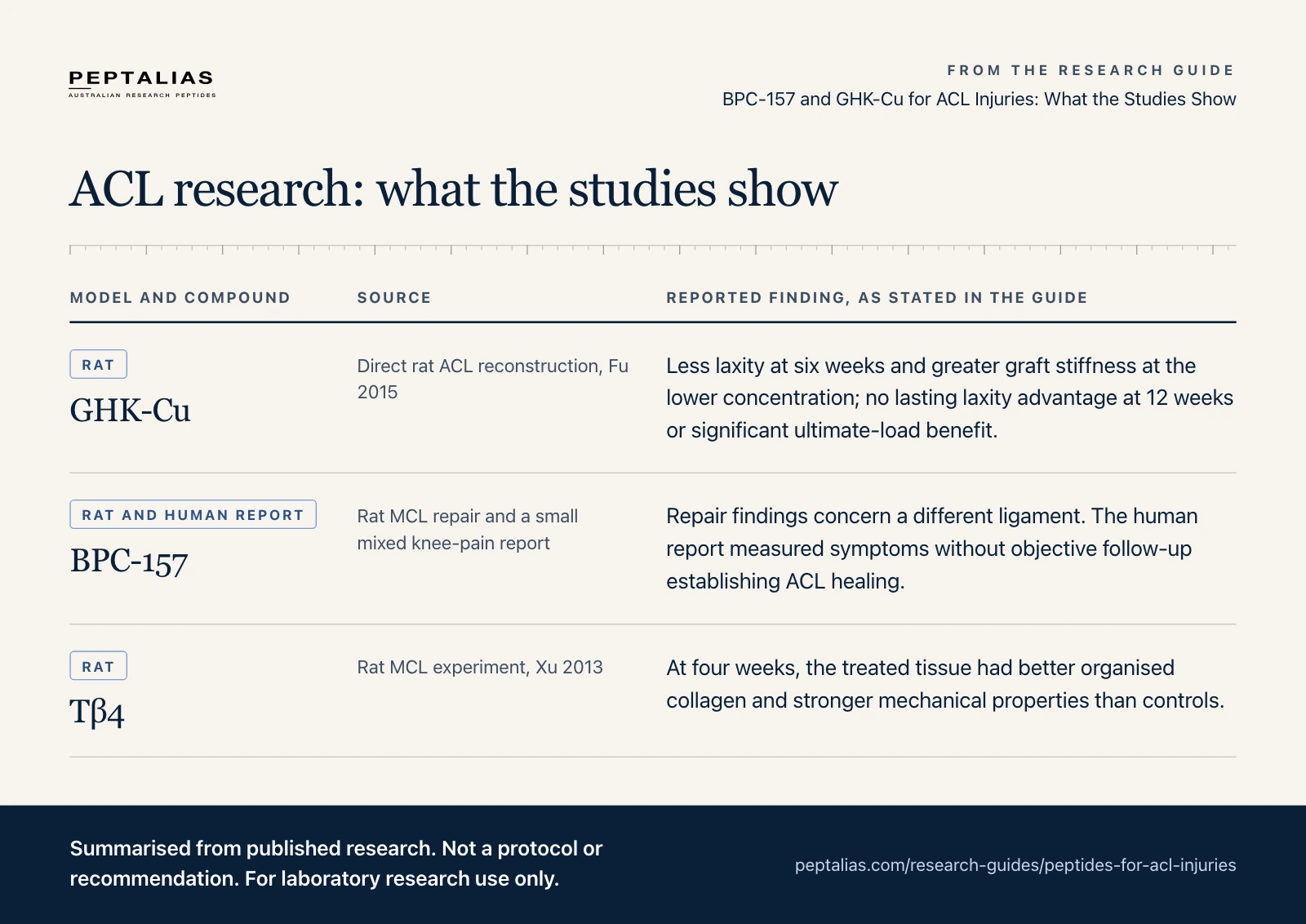
| Model | Compound | Source | Reported finding |
|---|---|---|---|
| Rat | GHK-Cu | Direct rat ACL reconstruction, Fu 2015 | Less laxity at six weeks and greater graft stiffness at the lower concentration; no lasting laxity advantage at 12 weeks or significant ultimate-load benefit. |
| Rat and human report | BPC-157 | Rat MCL repair and a small mixed knee-pain report | Repair findings concern a different ligament. The human report measured symptoms without objective follow-up establishing ACL healing. |
| Rat | Tβ4 | Rat MCL experiment, Xu 2013 | At four weeks, the treated tissue had better organised collagen and stronger mechanical properties than controls. |
Which part of ACL recovery are you trying to improve?
The anterior cruciate ligament helps stop the shin sliding forwards and controls rotation at the knee. A partial tear, an unstable complete rupture and a surgically reconstructed ACL are different biological problems. Treatment decisions depend on instability, other injuries and the activities someone wants to return to. AAOS's ACL guide describes both rehabilitation and surgical options.
| The actual question | What a useful benefit would look like | What the peptide evidence can currently answer |
|---|---|---|
| Can a partial ACL tear recover? | A stable knee, improved function and evidence of ligament continuity where appropriate | Rat MCL findings provide a repair hypothesis, not a tested human partial-ACL treatment. |
| Can a complete rupture reconnect? | A continuous, mechanically useful ACL, not just less pain | No controlled human result reviewed here establishes that BPC-157, TB-500 or KLOW achieves this. |
| Can recovery after reconstruction improve? | Better graft incorporation, fewer failures and restored function | GHK-Cu has direct rat ACL-reconstruction findings, with temporary benefits and important null results. Human benefit remains unestablished. |
| Can I return to running or pivoting sport sooner? | Strength, control and sport-specific readiness with acceptable reinjury risk | No verified peptide result here establishes a shorter safe return-to-sport timetable. |
Pain belongs in that comparison, but it cannot stand in for all the other outcomes. A knee can feel better before it is ready for cutting, landing or contact sport.
GHK-Cu has a direct rat ACL-reconstruction study
Fu and colleagues' 2015 study tested GHK-Cu after ACL reconstruction in 72 rats. At six weeks, treated groups had less knee laxity than saline controls, and the lower concentration improved graft-complex stiffness. By 12 weeks, the laxity advantage was absent. No significant benefit was found for ultimate failure load, gait or histological scores.
Here, laxity means looseness at the knee, stiffness means resistance to deformation, and ultimate failure load means the force the graft withstands before failing. They are separate measurements. Improved stiffness at six weeks does not prove a stronger final graft.
This is more anatomically direct than borrowing a skin-wound result. It identifies a possible early benefit and its limits, rather than proving a stronger final graft or validating KLOW. The full paper also allows concentration, timing and outcomes to be checked together.
What benefits has BPC-157 actually shown?
Better repair in a rat ligament experiment
Cerovecki and colleagues' 2010 study investigated surgically cut rat MCLs over an observation period extending to 90 days. The reported improvements covered function, mechanical performance, visible repair and microscopic tissue findings. BPC-157 was investigated by three routes: intraperitoneal injection, drinking water and topical cream.
That matters because it is ligament research, rather than a claim built entirely on skin or muscle experiments. It gives BPC-157 a concrete reason to appear in an ACL discussion: researchers observed better repair of injured connective tissue.
The MCL is the ligament on the inner side of the knee. The ACL sits within the joint and faces different mechanical and healing conditions. Changing “rat MCL” to “human ACL” does not close that gap.
Better knee pain in a small human report
Lee and Padgett's 2021 paper followed up 16 patients by telephone after knee injections at one clinic. Twelve received BPC-157 alone; 11 reported improved knee pain. Four received BPC-157 plus thymosin beta-4; three reported improvement.
There was one MRI-identified ACL tear among the patients, and that person reported improvement after BPC-157. However, the researchers did not perform objective follow-up testing to show ACL healing. The group had mixed knee problems, no untreated comparison group and no standardised functional outcome tool. The result supports further investigation of symptoms, not a claim that an ACL was rebuilt. The full paper and its tables make that distinction possible.
Tendon-to-bone healing is a separate question
An ACL reconstruction often uses a tendon graft. Researchers are therefore interested in the interface where tendon and bone meet. In Krivic and colleagues' 2006 rat experiment, BPC-157 improved functional, mechanical and tissue measures after the Achilles tendon was detached from the heel bone.
That is background for a graft-healing hypothesis, rather than a test of ACL reconstruction. The proposed benefit is better tissue attachment; human graft failure and sporting clearance were not measured.
Does TB-500 add something BPC-157 does not?
Thymosin beta-4, usually shortened to Tβ4, has a separate ligament experiment. Xu and colleagues in 2013 placed 1 microgram of Tβ4 in 100 microlitres of fibrin sealant into a cut rat MCL. At four weeks, the treated tissue had better organised collagen and stronger mechanical properties than controls.
The result makes collagen organisation and strength plausible research endpoints. It does not establish that a subcutaneous TB-500 schedule heals an ACL. The experiment used local sealant delivery and Tβ4, not a retail blend.
The name also needs checking. Full-length Tβ4 contains 43 amino acids. Esposito and colleagues' analytical study identified a seven-amino-acid, acetylated segment in the material sold as TB-500 that they analysed. This identifies that sample, not every TB-500 product. Our TB-500 versus thymosin beta-4 guide explains why the sequence matters before borrowing a study's result.
BPC-157, GHK-Cu, Wolverine or KLOW: what changes?
The difference is composition. A single material allows its contribution to be studied separately; a fixed blend changes several components together. Convenience and biological superiority are different claims.
| Option | What it contains in the PEPTALIAS listing | What that changes in the ACL evidence |
|---|---|---|
| BPC-157 | One named peptide | The ligament and knee-pain findings above concern BPC-157; they still do not establish ACL restoration. |
| GHK-Cu alone | One named copper-peptide material | Allows GHK-Cu to be investigated separately. Its direct rat ACL-reconstruction findings were temporary and do not establish human benefit. |
| Wolverine blend | BPC-157 5 mg plus TB-500 5 mg, totalling 10 mg | Adds a second named component. The knee report used Tβ4, so it cannot validate an unspecified TB-500 blend or prove combination superiority. |
| KLOW | GHK-Cu 50 mg, BPC-157 10 mg, TB-500 10 mg and KPV 10 mg, totalling 80 mg | Includes the GHK-Cu component studied separately in rat ACL reconstruction. That does not validate the four-component formula. |
Why KPV as well? KPV research investigated inflammatory signalling in intestinal/immune cells and mouse colitis. That is another proposed role, with a different evidence base. Neither a gut-inflammation finding nor the individual repair experiments demonstrate synergy in KLOW.
For the exact composition, see what KLOW contains. For fixed blend proportions versus separate materials, the Wolverine format comparison answers that different buying question.
What doses are reported, and where do they come from?
There is no established human ACL protocol for these peptides. Concrete amounts still help you judge a claim, provided the study or publisher stays attached to the number.
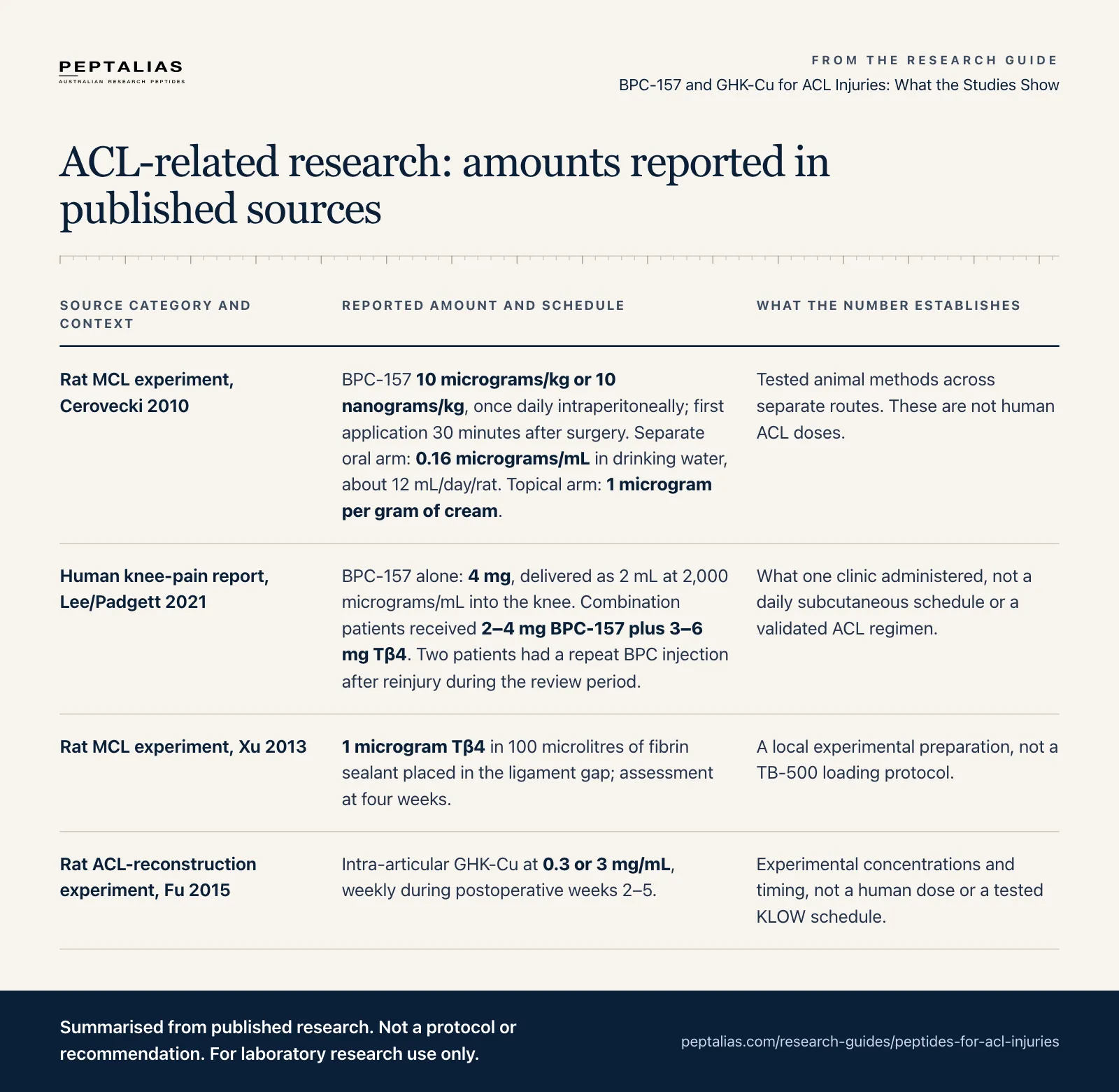
| Source category and context | Reported amount and schedule | What the number establishes |
|---|---|---|
| Rat MCL experiment, Cerovecki 2010 | BPC-157 10 micrograms/kg or 10 nanograms/kg, once daily intraperitoneally; first application 30 minutes after surgery. Separate oral arm: 0.16 micrograms/mL in drinking water, about 12 mL/day/rat. Topical arm: 1 microgram per gram of cream. | Tested animal methods across separate routes. These are not human ACL doses. |
| Human knee-pain report, Lee/Padgett 2021 | BPC-157 alone: 4 mg, delivered as 2 mL at 2,000 micrograms/mL into the knee. Combination patients received 2–4 mg BPC-157 plus 3–6 mg Tβ4. Two patients had a repeat BPC injection after reinjury during the review period. | What one clinic administered, not a daily subcutaneous schedule or a validated ACL regimen. |
| Rat MCL experiment, Xu 2013 | 1 microgram Tβ4 in 100 microlitres of fibrin sealant placed in the ligament gap; assessment at four weeks. | A local experimental preparation, not a TB-500 loading protocol. |
| Rat ACL-reconstruction experiment, Fu 2015 | Intra-articular GHK-Cu at 0.3 or 3 mg/mL, weekly during postoperative weeks 2–5. | Experimental concentrations and timing, not a human dose or a tested KLOW schedule. |
| Named clinic publication, LifeMed January 2020 catalogue, BPC page | Lists 300 micrograms subcutaneously nightly for 30 days, and a separate 500-microgram oral capsule daily for 30 days. | A published clinic convention. The page does not provide an ACL trial validating either schedule. |
These are incompatible contexts, not pieces of one programme. The knee study's 4 mg is 4,000 micrograms in a joint procedure; the LifeMed figure is 300 micrograms on a repeated schedule. Neither validates the other. A vial labelled 10 mg states its nominal contents, not how much a person should use.
Questions worth asking before trusting an ACL recovery claim
Can BPC-157 heal a partial ACL tear without surgery?
That has not been established by the evidence reviewed here. Partial tears do not all behave alike. The important clinical question is whether the remaining ligament provides enough stability for the person's activities. A rat MCL result cannot decide that, and improvement during rehabilitation does not isolate a peptide's effect.
Can KLOW make a reconstructed graft stronger?
The GHK-Cu component has a relevant animal graft experiment, but no human ACL-graft result here demonstrates a KLOW benefit. A convincing test would assess the actual formula, graft outcomes and function against an appropriate comparison.
Does less pain mean it is safe to return to sport?
No. Symptoms, knee stability, strength and control are separate parts of recovery. Return-to-sport decisions belong to the treating rehabilitation and surgical team; no peptide result discussed here supplies a shortcut around their assessment.
Does a COA prove the peptide will work for an ACL?
No. An analytical report and an efficacy study answer different questions. The PEPTALIAS-linked BPC-157, GHK-Cu, TB-500 and blend reports inspected on 20 October 2026 are labelled reference templates. They do not establish a link to current stock, sterility or ACL effectiveness. Our laboratory-report guide explains the fields to check and the evidence to request.
Compare the research, then the material
Start with the BPC-157 research guide for the broader ligament and symptom research, or the GHK-Cu guide for copper-peptide background. Researchers can inspect BPC-157 or GHK-Cu product details before comparing either single material with a blend. Read the components and the report's scope together.
PEPTALIAS materials are supplied for laboratory research, not human or veterinary use. This article explains research and reported quantities; it does not provide a personal treatment plan.