
Peptides for Hair Growth: GHK-Cu, AHK-Cu and the Evidence
Research context reviewed 20 October 2026
AHK-Cu has increased elongation of isolated human scalp follicles, while topical GHK-Cu has shown a small eyebrow-hair benefit in an 18-person study. These are different molecules, hair sites and experiments. Neither result establishes injected GHK-Cu as a treatment for a thinning scalp.
Use four checks: molecule, hair site, route and measured outcome. They show which claim an experiment can support.
| Candidate | Most relevant evidence discussed here | Potential benefit actually investigated | What remains unanswered |
|---|---|---|---|
| AHK-Cu | Isolated human scalp follicles and cultured cells | Follicle elongation and dermal-papilla cell activity | Visible regrowth on a living scalp; effective topical or injected amount |
| GHK-Cu topical serum | Small split-face eyebrow study | Eyebrow hair count, diameter and appearance | Replication, scalp-pattern hair loss and long-term benefit |
| GHK-containing ALAVAX | Small human scalp trial of a different complex | Hair count in a marked scalp area | Contribution of GHK alone or GHK-Cu |
| KLOW | Component rationale; no controlled hair trial identified | No controlled hair outcome for the complete blend identified in this review | Whether the blend adds anything to GHK-Cu or existing hair treatment |
What are GHK-Cu and AHK-Cu?
GHK-Cu contains glycine, histidine and lysine bound to copper. AHK-Cu swaps glycine for alanine. That single letter identifies a different molecule; a paper studying AHK-Cu cannot simply be cited as a GHK-Cu trial.
KLOW is a blend rather than another copper peptide. PEPTALIAS lists its nominal 80 mg formula as 50 mg GHK-Cu plus 10 mg each of BPC-157, TB-500 and KPV in the KLOW composition guide. Those amounts describe the vial composition, not a hair-growth dose. A positive result for one component still leaves the complete blend, its proportions and delivery route to be tested.
The GHK-Cu guide explains the copper complex itself. This article focuses on the separate question of hair outcomes.
What did the AHK-Cu follicle experiment show?
Pyo and colleagues' 2007 paper exposed isolated human scalp follicles and dermal-papilla cells directly to AHK-Cu. Follicles grew longer over 12 days at concentrations of 10⁻¹² to 10⁻⁹ mol/L. Higher tested concentrations, 10⁻⁸ and 10⁻⁷ mol/L, inhibited elongation. The experiment does not support a simple “more copper peptide means more growth” claim.
The papilla-cell findings offer a possible explanation: increased cell activity and changes in proteins associated with cell survival. However, the direct reduction in apoptotic cells was not statistically significant. Describing the study as proof that copper peptides prevent follicle death overstates it. Pyo et al., exact paper PDF.
This is a useful early result because it uses human follicles. But those follicles were outside the body, bathed in culture medium. The experiment bypassed the delivery problem faced by a scalp serum and never tested an injection.
Is there human evidence for GHK-Cu itself?
Yes, there is a small eyebrow report that should be separated from scalp claims. Bo and colleagues' May 2026 proceedings paper describes 18 adults applying nominal 2% GHK-Cu serum twice daily for 12 weeks to one eyebrow, with vehicle on the other.
At week 12, the reported mean count in the sampled 1 cm² eyebrow area was 30.50 hairs on the active side and 28.67 on the vehicle side, a difference of approximately 1.83 hairs between sides at that visit, not a baseline-adjusted change. The between-side comparison was significant at p=0.049. Diameter and photographic assessments also favoured the active side. This is a small, short study in people with sparse eyebrows, not a trial of male or female scalp-pattern loss. Bo et al., record and linked full paper.
Eighteen participants cannot settle how well other serums work, whether benefit lasts after stopping, or whether this formulation helps a receding hairline.
What about the trial reporting dozens of extra scalp hairs?
Lee and colleagues studied ALAVAX, a complex of 5-aminolevulinic acid and GHK, in a small six-month trial reporting 45 men with pattern hair loss. It was not GHK-Cu alone. Participants used a topical spray once daily at 50 or 100 mg/mL of the complex, or placebo.
Mean hair-count increases in the marked 1-cm-diameter scalp area were 71.5 with 50 mg/mL ALAVAX, 52.6 with 100 mg/mL ALAVAX, and 9.6 with placebo. The significant between-group finding was reported for the lower-concentration group's hair-count change ratio against placebo. Hair length and thickness did not differ significantly among groups. The higher concentration did not deliver the larger count increase. Lee et al., full text.
The important distinction is attribution. A two-part complex can produce a useful result without establishing that either ingredient alone produces it. Nor are “50 mg/mL ALAVAX” and “50 mg GHK-Cu vial” comparable quantities. One describes a formulation concentration; the other describes nominal material in a container.
What quantities have actually been studied?
The available numbers answer different questions. Keep the model and formulation attached to each one.
| Source category | Exact material | Reported quantity and timing | How to read it |
|---|---|---|---|
| Laboratory experiment | AHK-Cu in follicle culture | 10⁻¹² to 10⁻⁹ mol/L associated with elongation over 12 days | Concentration around isolated follicles; no human scalp dose |
| Small human proceedings study | Topical GHK-Cu eyebrow serum | Nominal 2%, twice daily, 12 weeks | Formulation-specific eyebrow investigation; applied mass per application not reported |
| Small randomised scalp study | ALAVAX, 5-ALA–GHK complex | 50 or 100 mg/mL spray, once daily, six months | Complex concentration, not GHK-Cu concentration or an injection schedule |
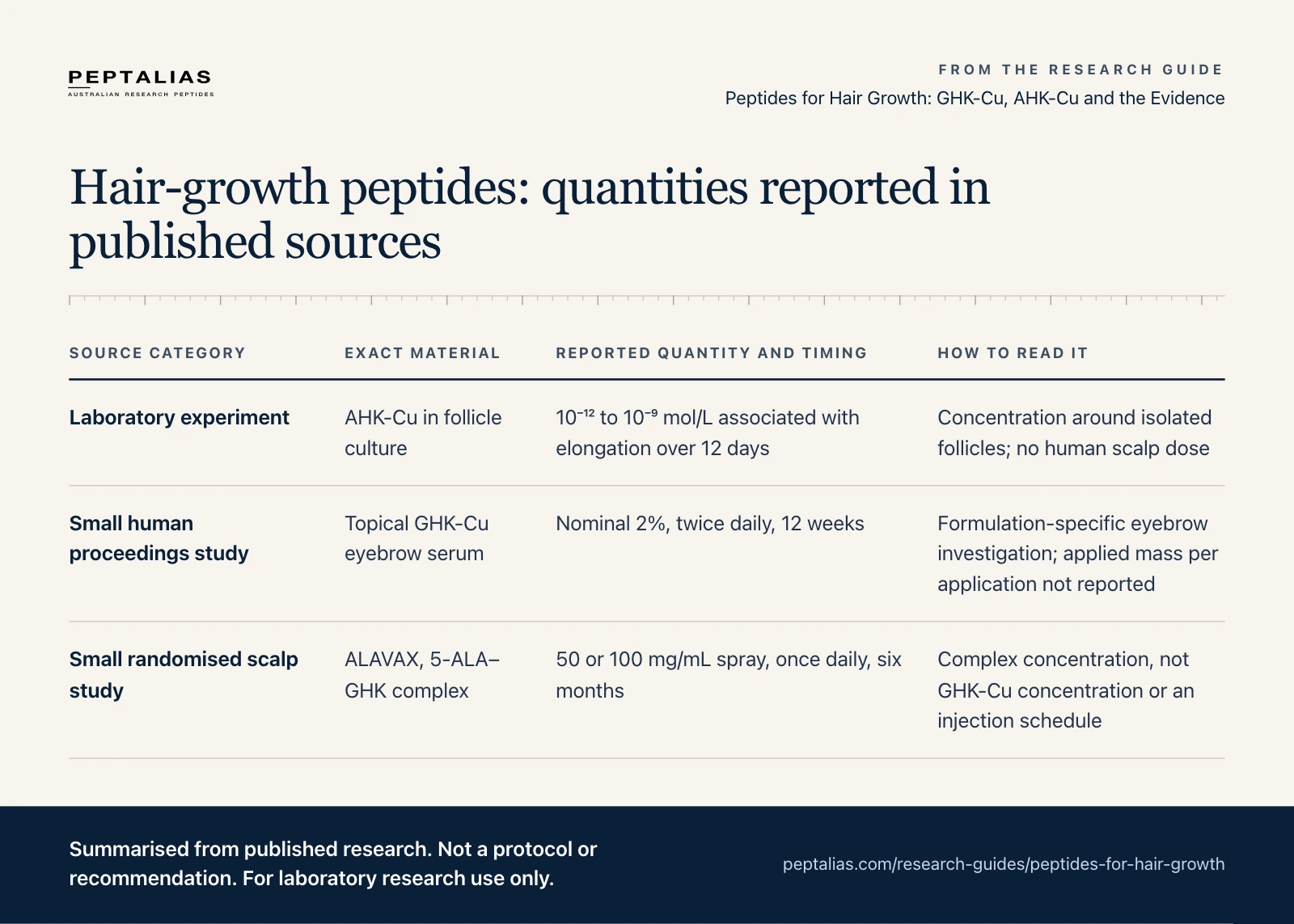
There is no sound calculation that turns these rows into an injected KLOW hair-growth regimen. The routes, molecules and exposure conditions differ before any arithmetic begins.
Does KLOW help hair, or is GHK-Cu enough?
The reviewed sources do not establish either as a proven scalp-hair treatment, and they do not demonstrate that KLOW outperforms GHK-Cu. KLOW adds three compounds, but ingredient count is not an outcome.
For a blend claim to be persuasive, a study would need to identify the exact formula, record the hair-loss condition, control other treatment and compare outcomes with an appropriate alternative. A photograph showing improvement after several new products cannot tell us which product caused it.
That matters particularly when minoxidil, finasteride, dutasteride, microneedling or a recent transplant are part of the same story. Existing treatment may still be producing delayed gains when a peptide is added. In the opened hair-results discussion, readers themselves identify the difficulty of separating copper-peptide results from concurrent hair drugs.
A fair conclusion is that copper peptides warrant further study. The complete KLOW blend still needs its own hair evidence.
How long would results take, and what should count as a result?
The studies used very different clocks: days for isolated follicles, weeks for eyebrows and months for the scalp complex. None supplies a reliable deadline for visible scalp improvement with GHK-Cu or KLOW.
Before accepting a results claim, identify the outcome:
- Less shedding: useful to the person reporting it, but not the same as regrowth.
- More hairs in a fixed area: stronger evidence of a density change when measured consistently.
- Thicker individual hairs: a separate outcome that can affect coverage.
- Better-looking photographs: meaningful, but sensitive to lighting, angle, styling and hair length.
A credible comparison uses the same scalp location, lighting and hair length, and records what else changed. An image can illustrate a report; it cannot repair missing controls.
Hair loss also has different causes. The American Academy of Dermatology recommends finding the cause before choosing treatment and describes established options such as minoxidil and prescription medicines for appropriate patients. Recovery from illness, scalp disease and hereditary loss do not present the same question. A GP or dermatologist can help identify the cause, especially with sudden loss, scalp inflammation or patchy loss. AAD diagnosis and treatment guidance.
Frequently asked questions
What is the best peptide for scalp hair growth?
The studies reviewed here do not establish a single best peptide for scalp regrowth. AHK-Cu has isolated-follicle findings, topical GHK-Cu has a small eyebrow result, and ALAVAX tested a different complex on the scalp. Compare those outcomes before comparing a serum, clinic service or research vial; the name “copper peptide” does not make those preparations equivalent.
Is AHK-Cu the same as GHK-Cu?
No. Alanine replaces glycine in AHK-Cu. Check the tested molecule before borrowing a hair-growth claim.
Is topical GHK-Cu better than injected GHK-Cu for hair?
There is no direct comparison in the reviewed evidence. A topical study cannot establish what injection achieves, and bypassing the skin barrier does not itself prove a hair benefit.
Does a 2% label tell me the dose reaching the follicle?
No. It describes a stated formulation concentration. Applied quantity, formulation quality and delivery to the target remain separate questions; the eyebrow paper does not report an applied mass per application.
Can copper peptides reverse grey hair?
The studies discussed here do not establish reversal of grey scalp hair. Pigmentation and hair density are separate outcomes.
Should I compare GHK-Cu with KLOW before looking at product details?
Yes. Start with the molecule and research question. Read what GHK-Cu is, then what KLOW contains. If the single compound fits the research question, the GHK-Cu product page provides its current listed format. A catalogue listing does not establish equivalence to a study serum or a hair-growth result.