
KPV Peptide Benefits: Gut Inflammation, Skin Research and Dosage Evidence
Research context reviewed 20 October 2026
KPV's clearest proposed benefit is reducing inflammatory signalling. The strongest directly relevant research involves intestinal cells and mouse colitis, with separate experiments on skin cells and peptide delivery through skin. These findings explain the interest in KPV for gut and skin research. They do not yet establish a treatment dose or a reliable symptom benefit in people.
The useful question is therefore more specific than whether KPV “reduces inflammation”: which tissue, which formulation and which measured result? A change in a cell's inflammatory signal, less severe mouse colitis and relief from a person's eczema are three different findings. Only the first two have direct support in the central gut study discussed below.
Contents: Benefits · Gut research · Skin research · Dosage evidence · KPV and KLOW
KPV benefits at a glance
| Question | What the directly relevant evidence shows | What remains unanswered |
|---|---|---|
| Can KPV affect intestinal inflammation? | Human intestinal cell lines and immune cells showed changes in inflammatory signalling; oral KPV reduced inflammation in two chemically induced mouse colitis models | Whether it improves a defined bowel disease in people, and at what dose |
| Can it protect skin cells? | A 2025 study reported protection of human keratinocytes and a 3D skin model against particulate pollution injury | Whether a finished product improves clinical skin symptoms |
| Does KPV pass through skin? | A human cadaver-skin experiment found poor passive passage, improved with assisted delivery | Exposure, tolerability and benefit in living users |
| Does it help IBS, eczema or psoriasis? | These are understandable questions, but the experiments above are not clinical trials in those conditions | Condition-specific controlled human results |
| Is KPV the same as KLOW? | KPV is one peptide; KLOW combines four ingredients | Whether the complete blend has effects beyond those of its individual ingredients |
The studies are linked in the relevant sections so the finding can be checked against its original experiment.
What is KPV peptide?
KPV stands for lysine–proline–valine, a sequence of three amino acids. It corresponds to the final three amino acids of alpha-melanocyte-stimulating hormone, usually shortened to alpha-MSH. That relationship explains why KPV appears in melanocortin research, but the fragment and the complete hormone are not interchangeable. Dalmasso and colleagues' primary record identifies KPV and its intestinal research directly.
This distinction matters when evaluating a benefit list. A paper titled “alpha-MSH and wound healing” may have administered the complete hormone, a modified fragment or a multicomponent formulation. It cannot automatically support the same claim for standalone KPV. Even a matching three-letter sequence needs its actual experimental context.
Gut inflammation: the main KPV research question
In their 2008 Gastroenterology paper, Guillaume Dalmasso and colleagues examined KPV in intestinal epithelial cell lines, Jurkat immune cells and mice with colitis induced with the chemicals DSS or TNBS. The mouse experiments supplied KPV in drinking water. The cell work found inhibition of NF-κB and MAP kinase signalling, pathways that help regulate inflammatory responses, and reduced pro-inflammatory cytokine secretion at nanomolar concentrations. The mouse work reported reduced intestinal inflammation. Primary study record.
The study also investigated PepT1, a transporter that carries small peptides into cells. Its findings support transporter-mediated uptake as part of the explanation for KPV's effects in those systems. That is more informative than describing KPV as a general “gut-healing peptide”: the experiment connects a particular molecule, an uptake route and inflammatory measurements.
The full paper is indexed as PMC2431115. The accessible primary abstract supports the findings above; it does not supply a clinical dosing protocol.
Does this mean KPV helps IBS?
It does not establish that conclusion. The mouse experiments modelled chemically induced colitis, an inflammatory injury. A reader searching for IBS may be concerned about abdominal pain, bowel habit or bloating. The cited study did not test symptom relief in people with IBS.
The same distinction applies to inflammatory bowel disease. A mouse colitis result is relevant to a biological question about intestinal inflammation. It is not a measured remission rate in human ulcerative colitis or Crohn's disease. To answer that clinical question, a trial would need a defined diagnosis, a consistent formulation, a comparator and disease-specific outcomes.
Skin benefits: what has actually been tested?
There is direct KPV skin research beyond extrapolating from alpha-MSH. Sung and colleagues' 2025 study exposed HaCaT human keratinocytes, a skin-cell line, to PM10 particulate matter. In the accessible primary abstract, 50 µg/mL KPV improved cell viability and reduced secretion of IL-1β, an inflammatory signalling protein, with changes in oxidative stress and inflammatory signalling. The authors also reported reduced inflammatory cell death in a 3D skin model. Primary record, publisher DOI.
The proposed benefit here is protection against a defined environmental injury in experimental skin systems. It is a relevant skin finding, but it does not measure eczema severity, acne clearance, psoriasis plaques or scar appearance in patients.
That narrower description gives the result practical meaning. Skin cells are exposed to many kinds of stress. Evidence for one challenge does not establish the same response to every inflammatory skin condition, and treating cultured cells directly bypasses some of the delivery problems a finished topical product must solve.
Why the delivery study matters
Pawar and colleagues' 2017 study examined KPV passage through dermatomed human skin. Passive diffusion was below the assay's detection level; microneedles, iontophoresis (electrically assisted delivery) or their combination increased permeation. This was an experiment with human skin tissue, rather than a clinical symptom trial. Primary study.
The implication is about formulation: applying a peptide to the surface, getting it into a particular skin layer and changing a clinical outcome are separate steps. A concentration that works when added directly to cells cannot be assumed to reach those cells through intact skin at the same level.
It would also be misleading to read the assisted-delivery result as instructions for a home procedure. The study's purpose was to measure transport under defined experimental conditions. It did not validate every cream, injection or delivery device carrying the KPV name.
KPV dosage: what the published numbers mean
There is no established human KPV dose for gut inflammation or skin symptoms in the sources reviewed here. There are concrete experimental amounts and proposed formulation strengths, but they answer different questions.
| Source and category | Reported amount or formulation | Model and route | What the number establishes |
|---|---|---|---|
| Dalmasso et al., 2008; primary research | Nanomolar concentrations in the accessible abstract | Cell experiments; separate mouse work used drinking water | An experimental cell concentration, not a person's daily amount |
| Sung et al., 2025; primary research | 50 µg/mL | KPV added to HaCaT cell experiments | The concentration associated with the reported cell findings |
| FDA's July 2026 KPV briefing; historical, withdrawn compounding nomination | Proposed 0.1% cream/gel | A nominated topical product strength | A proposal documented in a dossier, rather than a tested clinical dose |
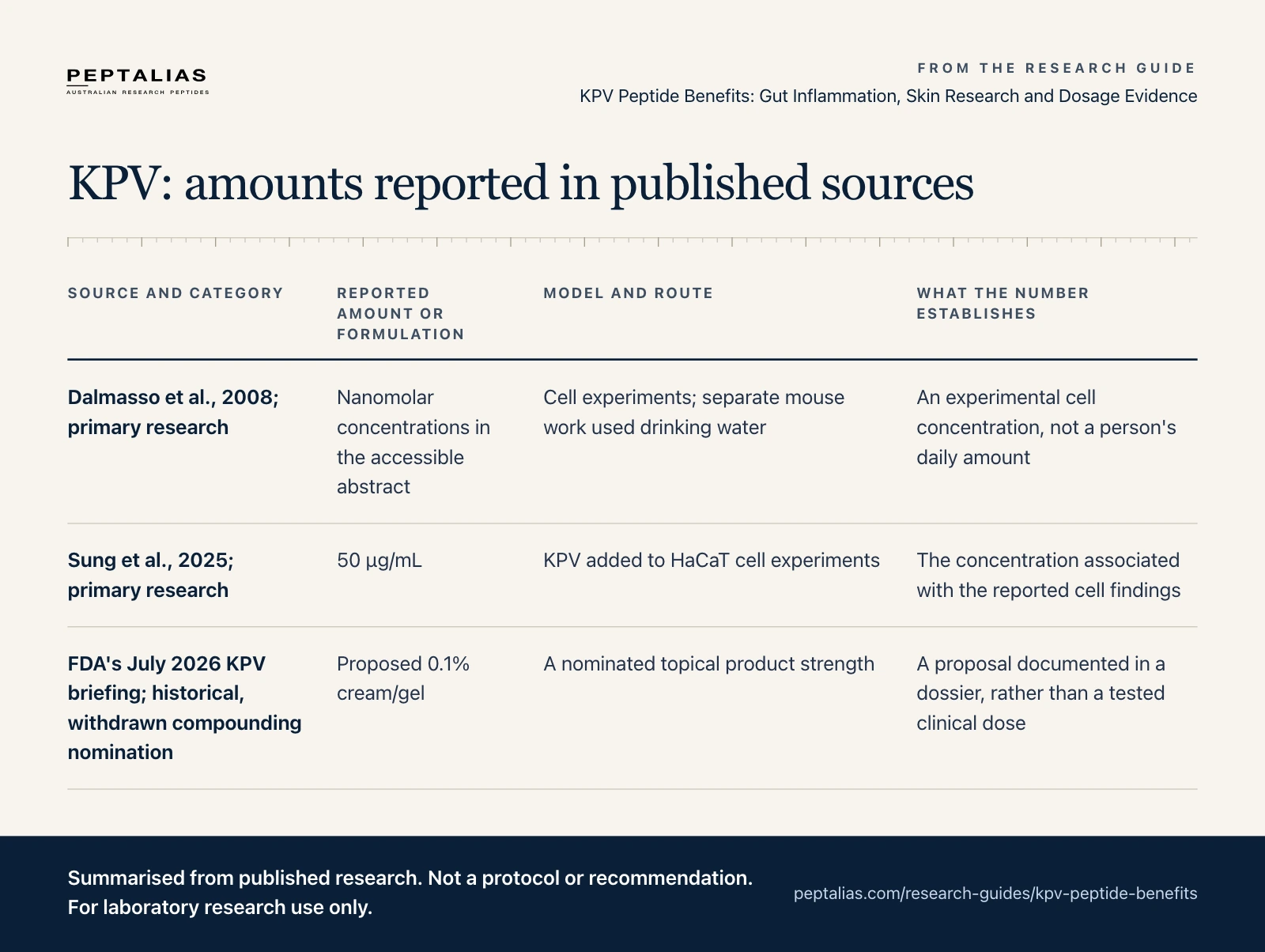
The FDA briefing states that the nomination was withdrawn and that FDA evaluated KPV on its own initiative. During that evaluation, it had not identified clinical studies of KPV administered to humans. The historical 0.1% proposal is neither an endorsement nor an established effective concentration.
Units are part of the answer. µg/mL is mass per volume; nanomolar is a molecular concentration; a percentage describes a formulation basis that must be specified. None independently supplies the total amount reaching a tissue. A vial's labelled milligrams describe nominal material quantity, not a validated duration or dose schedule.
This is also why an animal dose cannot be turned into a human regimen by multiplying by body weight. That calculation would skip formulation, exposure, metabolism and the human outcome that still needs testing.
KPV alone versus KPV inside KLOW
Standalone KPV and KLOW answer different material-selection questions. KPV isolates one peptide. The KLOW guide describes a blend containing GHK-Cu, BPC-157, TB-500 and KPV.
A standalone design can ask whether adding KPV changes a specified endpoint while other conditions stay constant. A blend introduces several ingredients at once. If the result changes, identifying the responsible ingredient or interaction requires additional comparisons.
That is why evidence for KPV's cell or mouse effects should remain labelled as component evidence when discussing KLOW. It does not show that the complete blend reproduces the result, that the components act synergistically or that a blend is better than KPV alone.
Likewise, the KPV versus BPC-157 comparison is useful for comparing research backgrounds. It does not provide a head-to-head clinical winner for gut symptoms.
Which formulation matches which research question?
| Preparation or setting | Question it can address | What still needs measuring |
|---|---|---|
| KPV added directly to intestinal or skin-cell cultures | Does a known exposure change the selected cellular response? | Delivery and outcomes in a whole organism |
| KPV in mouse drinking water | Does oral exposure affect chemically induced colitis in that model? | Human exposure and disease-specific benefit |
| KPV applied to cadaver skin in a transport experiment | How much passes through the skin under those conditions? | Tolerability and symptom benefit in living participants |
| Historical nominated 0.1% cream/gel | What strength a nominator proposed | A tested formulation, exposure and clinical result |
For a gut experiment, access to intestinal tissue matters. For a skin formulation, passage through the outer barrier matters. Those are different delivery problems, so a single “KPV dose” cannot describe them all.
Frequently asked questions
What are the main potential benefits of KPV?
The clearest supported research themes are inflammatory signalling in intestinal models and protection against experimentally induced skin-cell injury. Human symptom benefits remain unestablished in the reviewed sources.
Is KPV the same as alpha-MSH?
No. KPV is the three-amino-acid C-terminal sequence associated with alpha-MSH. A study of the complete hormone or a modified derivative needs separate assessment before its result is applied to KPV.
Is oral KPV proven to work better than injections?
No comparative human evidence was identified that establishes a superior route. Oral administration in a mouse colitis experiment does not establish the bioavailability or clinical superiority of a human oral product.
How long does KPV take to work?
The available evidence does not establish a reliable human onset or treatment duration. A laboratory measurement at a study timepoint is different from a person's symptom timeline.
What should I check when comparing KPV materials?
Check the named compound, supplied format and the scope of its documentation. The KPV product page provides material information; the laboratory-report guide explains how to assess a report. A purity result, a tissue-delivery experiment and a clinical-benefit claim each require their own evidence.