
Peptides for nerve pain: ARA-290 and peripheral-neuropathy evidence
Research context reviewed 20 October 2026
For nerve pain linked to peripheral small-fibre neuropathy, ARA-290, also called cibinetide, has human research worth examining. Small trials found changes in symptoms and nerve measurements in specific populations.
In one sarcoidosis pilot, a symptom questionnaire score fell by 11.5 points with ARA-290 versus 2.9 with placebo; lower meant improvement. Pain results were mixed: the main pain measure improved similarly in both groups. A change in corneal nerve area, a lower symptom score and less pain remain different outcomes.
The strongest answer depends on the cause of the neuropathy. Research in sarcoidosis does not automatically establish benefit for chemotherapy-related neuropathy, an entrapped nerve or sciatica. Among the peptides considered here, ARA-290 has the more directly relevant human studies; BPC-157's traumatic nerve-repair work is in animals.
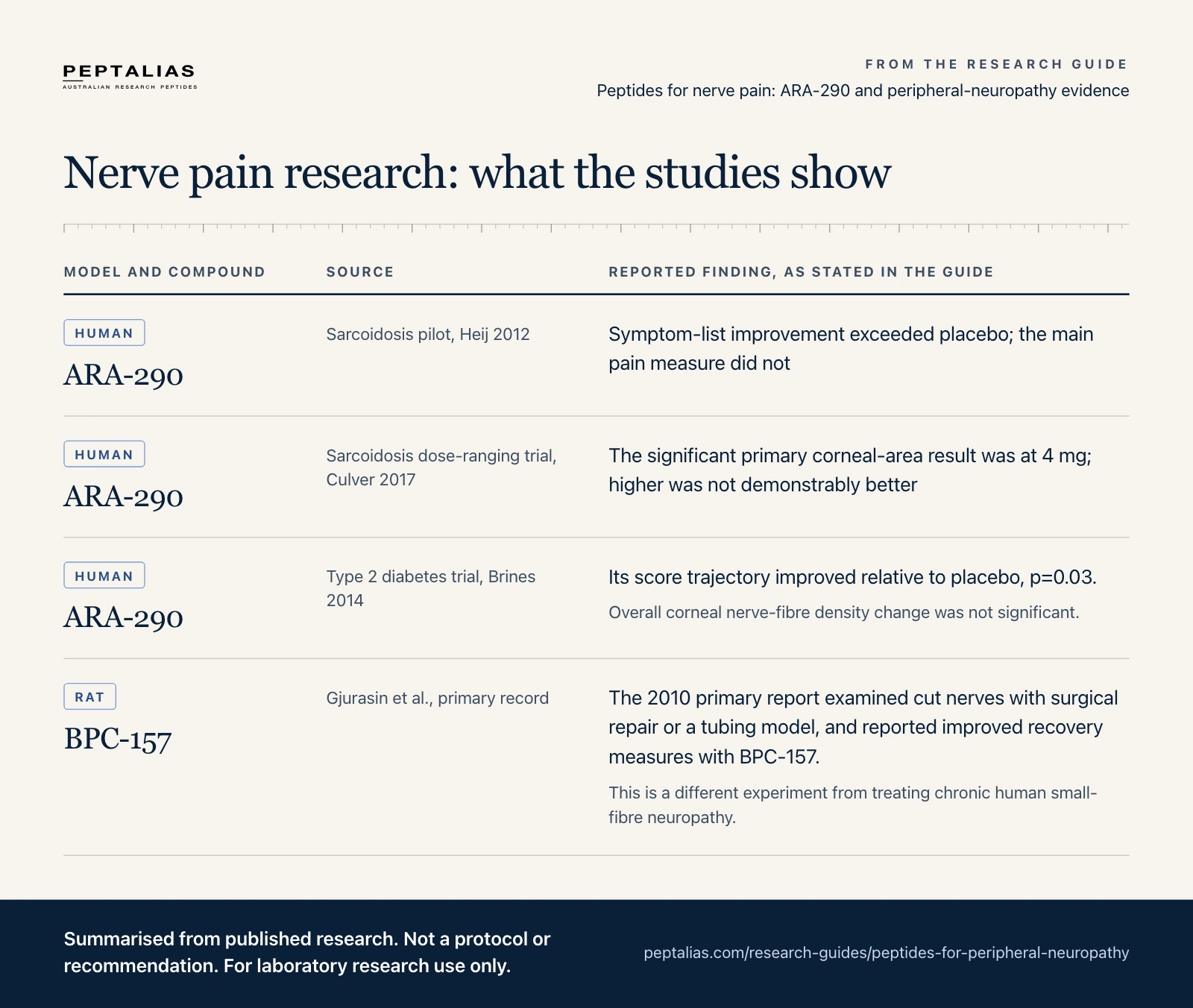
| Model | Compound | Source | Reported finding |
|---|---|---|---|
| Human | ARA-290 | Sarcoidosis pilot, Heij 2012 | Symptom-list improvement exceeded placebo; the main pain measure did not |
| Human | ARA-290 | Sarcoidosis dose-ranging trial, Culver 2017 | The significant primary corneal-area result was at 4 mg; higher was not demonstrably better |
| Human | ARA-290 | Type 2 diabetes trial, Brines 2014 | Its score trajectory improved relative to placebo, p=0.03. Overall corneal nerve-fibre density change was not significant. |
| Rat | BPC-157 | Gjurasin et al., primary record | The 2010 primary report examined cut nerves with surgical repair or a tubing model, and reported improved recovery measures with BPC-157. This is a different experiment from treating chronic human small-fibre neuropathy. |
What benefit is ARA-290 trying to produce?
ARA-290 is a synthetic 11-amino-acid peptide designed from part of erythropoietin's structure. Its research target is the innate repair receptor, with the aim of promoting tissue protection and repair without erythropoietin's red-blood-cell-stimulating effect. That mechanism is a rationale for investigation, not proof that every painful or numb nerve will recover. Heij et al., primary trial and full paper.
Three kinds of potential benefit need separate answers:
| Reader's question | Relevant endpoint | What would count as persuasive evidence? |
|---|---|---|
| Will the burning or stinging improve? | Pain intensity and symptom scores | A meaningful improvement beyond placebo in the relevant condition |
| Will damaged small fibres recover? | Corneal imaging or skin-biopsy measures | A controlled structural change, with its anatomical site and measurement identified |
| Will I function better? | Walking, daily activity or autonomic symptoms | Improved function rather than an imaging change alone |
A study can succeed on one row and remain uncertain on the others. This is why a headline about “nerve regeneration” can sound stronger than the clinical result beneath it.
Start with the type of neuropathy
Small-fibre neuropathy affects the small nerve fibres involved in pain, temperature sensation and autonomic functions. Peripheral neuropathy is a broader category, encompassing different nerve types and causes. Diabetes, immune disease, injury, nutritional problems and medicines can produce different patterns of nerve damage. Treatment therefore depends on identifying the cause and affected nerves. US National Institute of Neurological Disorders and Stroke.
The populations below matter because they were selected for particular research questions. A person with tingling in a hand after repeated compression is not interchangeable with a participant who had years of sarcoidosis-associated small-fibre loss.
Before comparing products, ask whether the cited trial actually studied the condition you are reading about. If it did not, the explanation must identify the extrapolation.
What did the sarcoidosis studies find?
Symptoms: an early controlled signal
In Heij and colleagues' 2012 pilot, 22 participants completed a four-week comparison. The active group received 2 mg intravenously three times weekly. Small Fibre Neuropathy Screening List scores fell 11.5 points with ARA-290 versus 2.9 with placebo; lower indicates fewer or less severe symptoms. This was a questionnaire change, not a percentage pain reduction. Brief Pain Inventory scores improved similarly in both groups. That supports a symptom signal in this population; it does not demonstrate superior pain relief on every measure. Heij et al., exact linked PDF.
Nerve measurements: promising, with a separate pain result
Culver and colleagues' 2017 phase 2b trial randomised 64 people with sarcoidosis-associated small-nerve-fibre loss and neuropathic pain to placebo or 1, 4 or 8 mg subcutaneously daily for 28 days.
The primary endpoint was corneal nerve fibre area. The 4 mg group showed a placebo-corrected increase of approximately 697 μm², with a 95% confidence interval of 159 to 1,236 and p=0.012. A skin marker of regenerating fibres, GAP-43-positive fibre length, also improved at 4 mg. Ordinary intraepidermal nerve-fibre density did not differ significantly between groups.
Pain improved in all groups. The moderate-to-severe-pain subgroup had an additional pain reduction at 4 mg that was not statistically significant, p=0.157. The between-group six-minute-walk comparison at that dose was also not significant, p=0.11. After treatment stopped, corneal nerve area trended back towards baseline. This does not establish a maintenance schedule or prove every symptom benefit disappeared. Culver et al., full paper.
What about diabetic peripheral neuropathy?
Brines and colleagues' 2014 paper analysed 48 people with type 2 diabetes and painful neuropathic symptoms. The study used 4 mg SC daily for 28 days, then 28 days of observation.
PainDetect is a questionnaire assessing the features of neuropathic symptoms. Its score trajectory improved relative to placebo, p=0.03. Within the active group, scores fell approximately 18% at day 28 and 23% at day 56 versus baseline. Those figures are changes in questionnaire score within the active group, not percentages of pain removed, placebo-corrected reductions or percentages of people who responded. Other symptom instruments did not show uniform benefit.
Overall corneal nerve-fibre density change was not significant. In a post hoc subgroup with low baseline density, the increase was 2.6 fibres/mm² in the active arm and 0.7 with placebo. The active-arm p=0.02 was a within-arm paired test. Significance in one arm alone does not establish a significant between-group difference.
The paper reports four serious adverse events in total in the ARA-290 arm; two were judged possibly related. Its safety account includes one participant whose treatment was stopped after renal function worsened, and a 70-year-old participant who was hospitalised with severe cellulitis two weeks after his last dose and suffered a fatal myocardial infarction. The safety committee judged that later event unrelated to ARA-290. Long-term safety remains uncertain. Brines et al., full paper.
The diabetic and sarcoidosis results support continued investigation. Combining them into one percentage chance of success would require evidence these studies do not provide.
What doses were studied, and are they a protocol?
The quantities below are study methods. They explain where common online figures come from. They are not a personal dosing plan, and they do not make a retail product equivalent to a clinical investigational formulation.
| Primary research context | Reported amount, route and duration | Main interpretive point |
|---|---|---|
| Sarcoidosis pilot, Heij 2012 | 2 mg IV, three times weekly, four weeks | Symptom-list improvement exceeded placebo; the main pain measure did not |
| Sarcoidosis dose-ranging trial, Culver 2017 | 1, 4 or 8 mg SC daily, 28 days | The significant primary corneal-area result was at 4 mg; higher was not demonstrably better |
| Type 2 diabetes trial, Brines 2014 | 4 mg SC daily, 28 days; 28-day follow-up | Symptoms and selected nerve measures; not universal repair or a maintenance schedule |
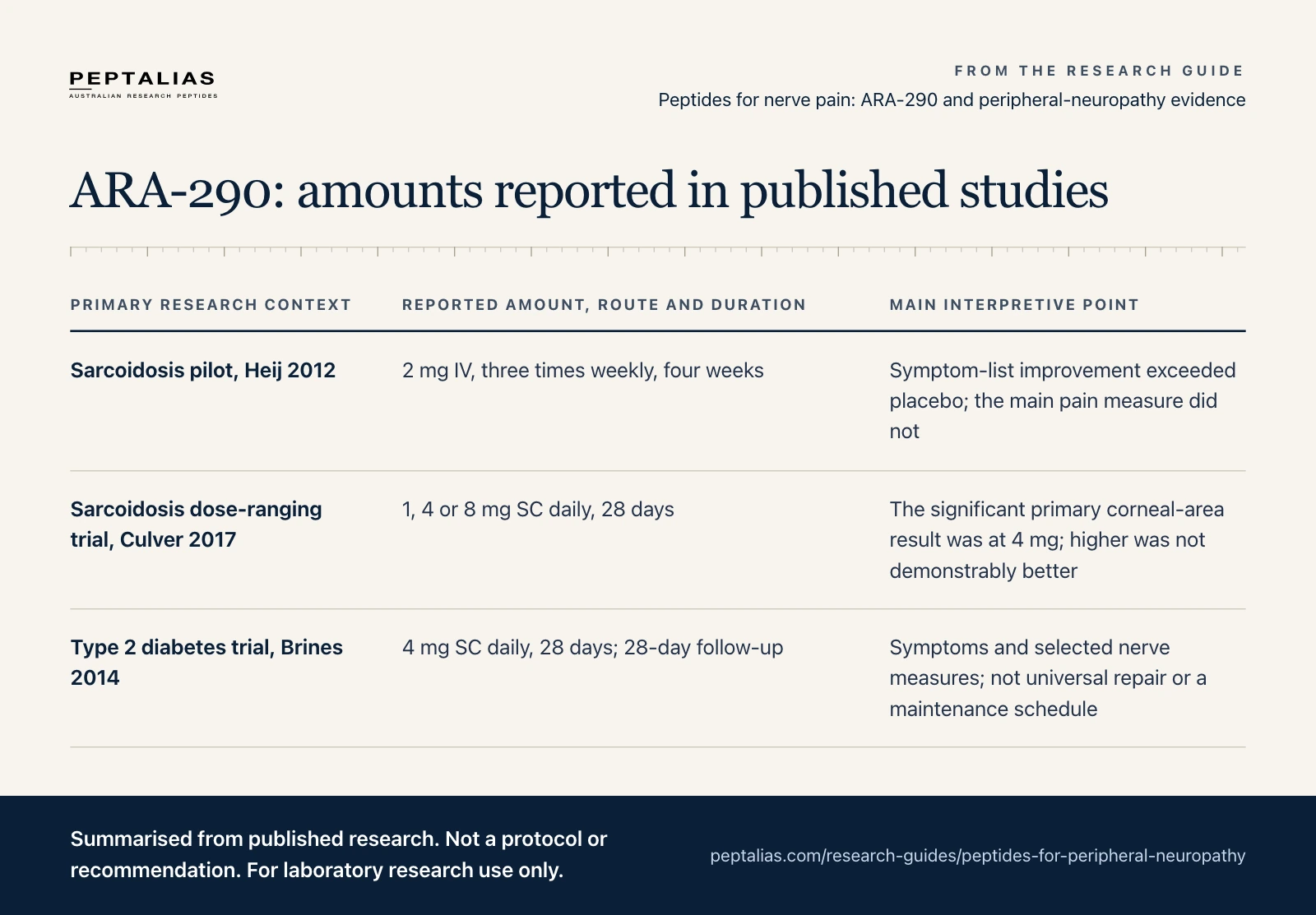
IV means intravenous; SC means subcutaneous. Changing route changes the exposure question. Milligrams and micrograms differ by a factor of 1,000. A printed “10 mg vial” is total nominal material in a vial, not an evidence-based daily amount.
These short trials do not establish an indefinite cycle, an escalation schedule for non-response or a combination with other research peptides. A proposed eight-week course from a guide needs its own source; it cannot be quietly added to a four-week trial.
How should you read publisher protocols and community results?
Named guides and community reports can show what people are discussing, but their source category matters. For example, ProtocolPlus's ARA-290 guide discusses the human research and 4 mg daily study context. It is a secondary explanation. It does not add a new controlled outcome to the papers above.
The opened public discussion “Neuropathy. Let's help each other.” contains experience questions, differing reported amounts and non-response. The contributors' diagnoses, supplied material and other treatments are not independently verified. Reports of benefit and no benefit are useful questions for research; neither establishes a responder rate.
A good account should state what changed: burning pain, numbness, sleep, walking or a test result. “My nerves improved” combines too many possibilities. It should also say what else changed and over what time. Those details make a report interpretable without turning it into clinical proof.
Is BPC-157 an alternative for nerve repair?
BPC-157 is discussed because of research on traumatic sciatic-nerve injury in rats. The 2010 primary report examined cut nerves with surgical repair or a tubing model, and reported improved recovery measures with BPC-157. This is a different experiment from treating chronic human small-fibre neuropathy. Gjurasin et al., primary record.
For the broader compound background, the BPC-157 research guide explains its separate tissue-repair evidence.
A surgically injured large nerve in an animal and small-fibre loss associated with a systemic disease differ in tissue, cause and outcome. The BPC finding earns a place in a nerve-research comparison. It does not establish equivalence to ARA-290, a human neuropathy dose or evidence that the two work better together.
| Comparison | ARA-290 | BPC-157 |
|---|---|---|
| Evidence most relevant here | Small controlled human studies in defined small-fibre conditions | Animal traumatic nerve-repair research |
| Key question | Symptoms and small-fibre measures in selected populations | Recovery after experimental nerve injury |
| Missing bridge | Broad causes, longer-term outcomes and routine clinical effectiveness | Controlled human peripheral-neuropathy outcomes |
Does a corneal nerve result mean all damaged nerves regrow?
No. Corneal imaging measures small fibres in the transparent front of the eye. It offers a way to examine nerve structure without repeatedly biopsying a foot, but it is still a measurement at a particular anatomical site.
Calling a corneal change a cure would require much more: sustained symptom and functional improvement, evidence relevant to the affected nerves and meaningful follow-up. Report the structural finding at its actual scale.
This distinction also explains why imaging and pain can disagree. A structural measure and an experience of pain ask different questions. A responsible comparison reports both, even when one is more encouraging.
Frequently asked questions
Is ARA-290 the same as cibinetide?
Yes. Cibinetide is the name used for ARA-290 in the later trial literature.
Does peptide research for nerve pain also establish a benefit for sciatica?
The studies discussed here do not establish that. The diagnosis and research population need to match before a result is applied to nerve compression.
Does 8 mg work better than 4 mg?
The reviewed dose-ranging study did not demonstrate that higher was better. Its positive primary endpoint should not become an online dose-escalation rule.
If someone feels no benefit, should the amount or duration increase?
These papers do not provide a validated escalation plan for an individual non-responder. Reassessing the diagnosis, outcome and evidence is more useful than assuming insufficient quantity caused the result.
Where can I check the material and documentation?
For defined human small-fibre research, ARA-290 has the closer evidence fit; BPC-157 answers an animal traumatic-nerve question. Start with the ARA-290 product information for the current listed research material, then use the laboratory-report guide to distinguish identity, purity and content claims. Documentation can help answer what was tested. It cannot establish that a retail vial reproduces a trial formulation or its clinical outcomes.