
Which peptides help with muscle growth and fat loss?
Research context reviewed 20 October 2026
The evidence points to different compounds for different outcomes. Retatrutide has substantial human weight-loss results. Tesamorelin has human visceral-fat results and exploratory evidence of increased trunk-muscle area in selected responders. Neither finding makes ipamorelin, CJC-1295 or MOTS-c a proven muscle-building treatment for a healthy gym-goer.
“Muscle growth and fat loss” combines at least two goals. Looking leaner, losing kilograms, reducing deep abdominal fat and getting stronger are not interchangeable results. The best comparison starts by deciding which change a study actually measured.
Compare the result you want, not just the peptide name
| Goal | What a useful study needs to measure | Where the evidence discussed here fits |
|---|---|---|
| Lose body weight | Change in kilograms or percentage of starting weight | Large retatrutide obesity trials |
| Reduce visceral fat | Imaging of fat inside the abdominal cavity | Tesamorelin trials in HIV-associated lipodystrophy and selected adults with obesity |
| Reduce subcutaneous fat | Fat under the skin, measured separately | Cannot be assumed from a visceral-fat result |
| Preserve or increase lean mass | Body-composition measurement, with its definition and method | Relevant tesamorelin and retatrutide results, but not identical outcomes |
| Increase muscle area or strength | Muscle imaging and separate strength testing | Tesamorelin computed tomography (CT) analysis found increased area in selected HIV/VAT responders; strength was not measured |
This avoids a common category error: comparing a growth-hormone increase from one study with weight loss from another, then calling the larger-looking number a better result.
Which candidates have human muscle or strength evidence?
Start here if muscle growth is the main question. The strongest weight-loss result does not automatically become the strongest muscle result. CT means computed tomography, used here to image muscle area and fat. DXA means dual-energy X-ray absorptiometry, used to estimate body composition. GH is growth hormone; IGF-1 is insulin-like growth factor 1, a hormone involved in growth signalling.
| Candidate | Actual human muscle or strength evidence in the sources reviewed | What it means for a muscle-growth comparison |
|---|---|---|
| Tesamorelin | Exploratory CT analysis in HIV-associated abdominal obesity: increased trunk-muscle area and density in 193 selected visceral-fat responders versus 148 placebo recipients over 26 weeks; strength/function not measured. | A direct human muscle-imaging signal, with selection and population limits. Lean-body-mass changes in its trials are a separate endpoint. |
| Long-acting CJC-1295 | Human GH/IGF-1 and pharmacokinetic studies, rather than hypertrophy or strength outcomes. | Hormone elevation does not prove larger or stronger muscles. Findings do not validate a No-DAC or CJC/ipamorelin blend. |
| Ipamorelin | The foundational study discussed here measured GH release in laboratory and animal systems. | It does not establish human muscle gain. |
| Retatrutide | Human type 2 diabetes DXA substudy recorded fat and lean-mass loss. No direct contractile-muscle or strength endpoint is established here. | A weight/fat-loss candidate; the body-composition evidence cannot be described as muscle building or fat-only loss. |
| MOTS-c | Human exercise study measured naturally produced MOTS-c; administered-peptide performance experiments were in mice. | An endogenous exercise response does not establish the effect of taking MOTS-c on human muscle or strength. |
The study details and primary links follow below: tesamorelin muscle imaging, CJC-1295 pharmacology, ipamorelin pharmacology, retatrutide body composition and MOTS-c exercise research.
Tesamorelin: what kind of fat loss has it shown?
Tesamorelin's strongest established clinical context is excess abdominal fat in adults with HIV-associated lipodystrophy. The US pharmaceutical label is specific to that indication and states it is not for general weight-loss management. It is a poor starting point for a promise that every person can use it to lose scale weight. Current EGRIFTA WR label.
There is also relevant research outside HIV. Makimura and colleagues randomised 60 adults with abdominal obesity and reduced growth-hormone secretion to tesamorelin 2 mg once daily or placebo for 12 months. The estimated treatment effect on CT-measured visceral fat was −35 cm². Subcutaneous abdominal fat did not change significantly between groups. Makimura et al., primary record.
That is a useful finding for the question “has tesamorelin been studied outside HIV?” It is not a trial in lean, resistance-trained adults seeking larger muscles. The selected hormonal and body-composition profile matters.
Visceral fat sits deeper in the abdomen around internal organs. Subcutaneous fat lies beneath the skin. Calling both “belly fat” hides the distinction. A reduction in the first does not prove targeted removal of the second, including a particular pocket of fat someone can pinch.
Does tesamorelin build muscle?
The pharmaceutical label reports mean lean-body-mass increases of approximately 1.2–1.3 kg after 26 weeks in the original clinical studies, alongside reductions in trunk fat. Those are relevant body-composition results. They are not a direct measure of added contractile muscle or proof of a matching strength gain. The same label warns about fluid retention, elevated IGF-1 and glucose intolerance. EGRIFTA WR, clinical studies and warnings.
There is also a more direct muscle result. Adrian and colleagues' 2019 exploratory analysis examined CT images from 193 tesamorelin responders and 148 placebo recipients with HIV and abdominal obesity. The active group was selected for at least an 8% visceral-fat reduction; this was not a comparison of every randomised tesamorelin participant.
Over 26 weeks, adjusted comparisons found greater lean muscle area across four trunk-muscle groups, with estimated treatment coefficients of 0.64–1.08 cm². Muscle density also improved. These are positive human muscle-imaging findings, beyond a change in whole-body lean mass.
The selection matters: the result describes people who had already responded on visceral fat. Strength and muscle function were not collected, so it cannot establish stronger lifts, improved daily function or the same benefit in healthy trained adults. Adrian et al., exact primary record.
Ipamorelin and CJC-1295: does raising GH prove muscle gain?
No. A hormone response is evidence that a compound affected signalling. It is not the same endpoint as hypertrophy, strength or fat loss.
Raun and colleagues' foundational ipamorelin paper studied growth-hormone release in laboratory and animal systems, including rat cells and swine. It established an interesting pharmacological profile, not a human muscle-gain outcome. Raun et al., exact primary record.
Teichman and colleagues' 2006 studies investigated long-acting, albumin-binding CJC-1295 over 28 and 49 days, measuring GH, IGF-1 and pharmacokinetics. The abstract discusses 30 or 60 micrograms/kg and sustained hormonal increases, not a bodybuilding outcome. One study used a single subcutaneous (SC) dose; the separate repeat-dose study used two or three doses spaced one or two weeks apart. The accessible abstract does not map each amount to each repeat schedule. Teichman et al., primary record.
The formulation distinction is essential. Findings from long-acting CJC-1295 cannot be transferred unchanged to material marketed as “No DAC”. Nor does a result for one compound establish what a fixed blend does. The ipamorelin versus CJC/ipamorelin guide explains those identity and composition questions.
Retatrutide: weight loss and fat mass are different headlines
Retatrutide activates GIP, GLP-1 and glucagon receptors. In the 2026 TRIUMPH-1 phase 3 trial, 2,339 adults with obesity without diabetes were randomised to weekly retatrutide or placebo for 80 weeks. The treatment-regimen, intention-to-treat analysis, which assesses the assigned groups regardless of treatment adherence, reports mean body-weight changes of −17.6%, −23.7% and −25.0% in the 4, 9 and 12 mg groups, versus −3.9% with placebo. These are body-weight results, not percentages of pure fat removed. Jastreboff et al., September 2026 primary record.
Does retatrutide cause muscle loss, or only fat loss?
The substudy recorded fat-mass and lean-mass loss. It did not measure loss of contractile muscle directly. Coskun and colleagues' 2025 DXA substudy in people with type 2 diabetes investigated weekly retatrutide over 36 weeks. Total fat mass fell by 26.1% in the pooled 8 mg groups and 23.2% in the 12 mg group, versus 4.5% with placebo. The authors also report lean-mass loss, with its proportion of weight loss similar to other obesity treatments.
The substudy had incomplete scans: 189 enrolled, 155 had baseline DXA, and 103 completed treatment with both baseline and week-36 scans. Its analysis used available on-treatment data. This is not a simple “all 189 completed” result or evidence of fat-only loss. Coskun et al., exact primary abstract.
Lean mass includes non-fat tissues and depends on the measurement method and hydration, so reported lean-mass loss cannot be relabelled as the same amount of lost contractile muscle. The study does not establish that every reader will lose a particular amount of muscle, or that muscle function or strength declines by the same percentage. Keeping fat, lean mass and tested muscle outcomes separate is the useful answer to the muscle-loss question.
Current status matters: Lilly's September 2026 information still describes retatrutide as investigational and not FDA-approved. Trial progress does not make online research material an approved medicine or equivalent to what participants received. Lilly's current retatrutide information.
Where does MOTS-c fit?
MOTS-c is relevant to metabolic and exercise research, but the human and animal parts of its story must stay separate.
Reynolds and colleagues' 2021 paper found that exercise increased naturally produced MOTS-c in human muscle and circulation. The people were not being treated with MOTS-c. In the same research programme, administered MOTS-c improved physical performance in mice. Some experiments used 5 or 15 mg/kg/day intraperitoneally; these are animal research quantities, not human schedules. Young-mouse running improvements did not mean every strength measure improved. Reynolds et al., full paper PDF.
As checked on 20 October 2026, the sponsor-reported MOTS-MET registry, NCT07505745, displayed recruiting for a human MOTS-c study in adults with prediabetes and overweight or obesity, with no posted results. Registration shows that an intervention is being investigated; it does not establish a muscle, fat-loss or strength benefit.
The attractive idea is a relationship between mitochondrial signalling, metabolism and physical capacity. The missing bridge is controlled human evidence that taking MOTS-c produces the desired muscle or fat change. An endogenous exercise response does not supply that bridge, and multiplying a mouse amount by human body weight would not solve it.
What quantities do the studies and labels actually discuss?
This table preserves the source context. It does not assemble a cycle or stack.
| Source category and exact material | Reported amount and timing | Purpose and limit |
|---|---|---|
| Human trial, tesamorelin in selected adults with obesity | 2 mg daily, 12 months | Visceral-fat research; not a healthy-gym-population muscle regimen |
| US label, EGRIFTA WR | 1.28 mg SC daily | Exact pharmaceutical formulation and HIV-related indication |
| US label, EGRIFTA SV | 1.4 mg SC daily | Different formulation; not substitutable with WR |
| Human phase 3, retatrutide TRIUMPH-1 | 4, 9 or 12 mg target groups, weekly, 80 weeks | Trial arms and weight outcomes, not instructions to start at a target amount |
| Human pharmacology, long-acting CJC-1295 | SC; 30 or 60 micrograms/kg discussed. Single-dose study; separate study used two or three doses spaced one or two weeks apart | Accessible abstract does not map amounts to each repeat schedule. Hormone/PK study, not a No-DAC blend regimen |
| Animal experiment, MOTS-c | 5 or 15 mg/kg/day IP in selected mouse experiments | Preclinical performance/metabolic investigation, not a human conversion |
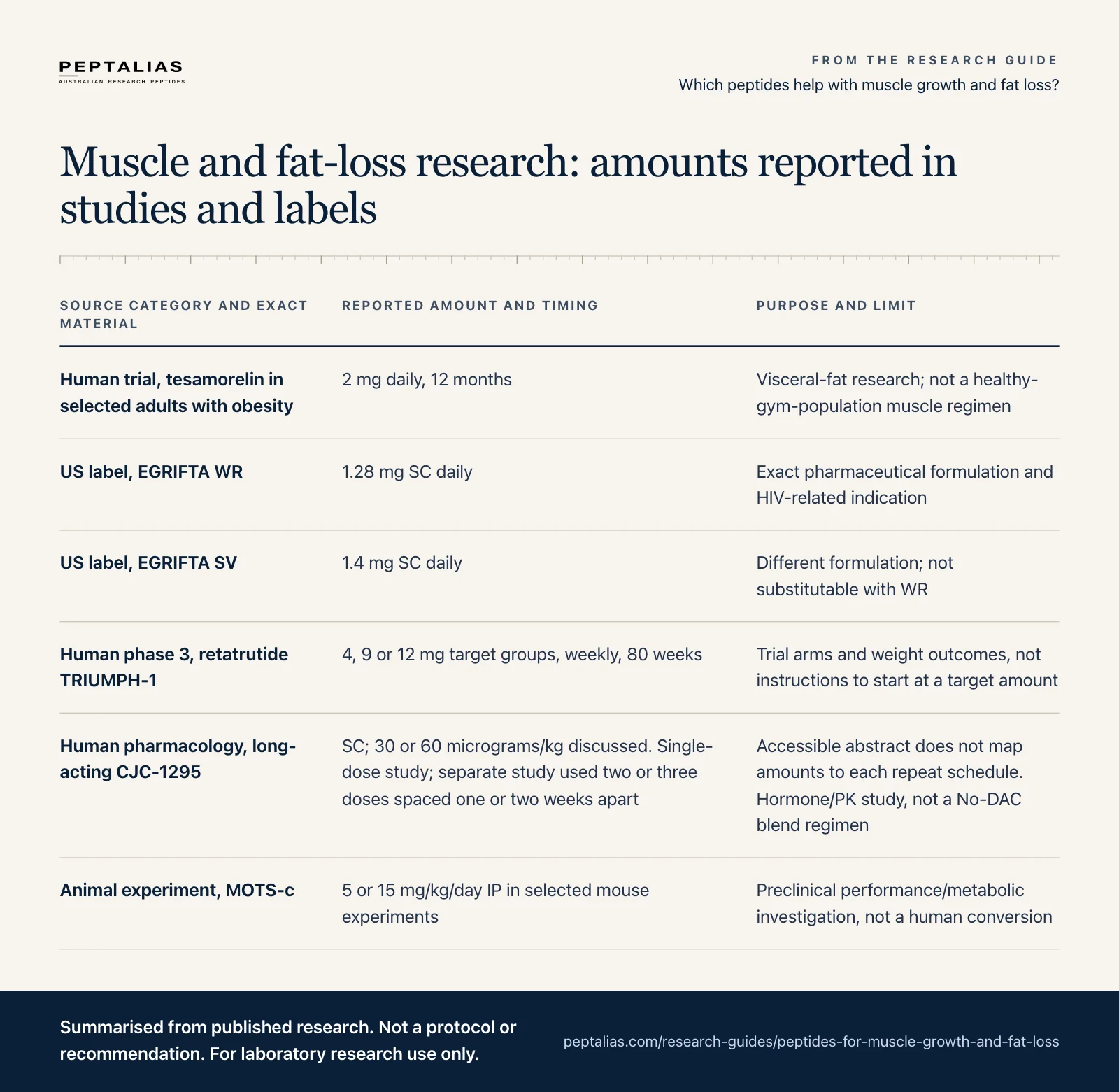
The two EGRIFTA labels illustrate why the generic peptide name is insufficient. The WR formulation has an 11.6 mg vial and a labelled 1.28 mg daily dose; SV has a 2 mg vial and a labelled 1.4 mg daily dose. Their official instructions differ. Neither supplies instructions for a separately supplied research vial. WR label, SV label.
Can you lose fat and gain muscle at the same time?
The research question is legitimate. The mistake is treating two separate outcomes as if one trial result answers both.
A useful recomp comparison needs baseline and follow-up fat and muscle measurements, a clear population and information about diet and training. If strength is promised, strength also needs testing.
For illustration, imagine someone starts at 100 kg with 30 kg fat mass. After losing 10 kg, they weigh 90 kg with 23 kg fat mass. Their body-fat percentage falls from 30% to about 25.6%, but the remaining 3 kg of weight loss was not fat. These are hypothetical numbers, not a retatrutide forecast. They show why a better percentage can coexist with loss of non-fat mass.
No controlled evidence in the sources reviewed here establishes that combining retatrutide, tesamorelin, ipamorelin and MOTS-c delivers both outcomes better than an appropriate comparator. Adding mechanisms together cannot substitute for testing the combination.
Frequently asked questions
Which has the stronger evidence for general weight loss: tesamorelin or retatrutide?
Retatrutide has large obesity-trial weight outcomes. Tesamorelin's clinical indication and strongest body-composition context concern excess abdominal fat in HIV-associated lipodystrophy, with selected research outside that population. They are different comparisons, and retatrutide remains investigational.
Does a GH increase make CJC/ipamorelin a proven recomp blend?
No. The exact blend needs outcome evidence. Hormone findings for long-acting CJC-1295 do not validate a differently formulated commercial combination.
Will tesamorelin specifically remove love handles?
The reviewed visceral-fat findings do not establish targeted loss of a particular subcutaneous pocket.
What is the useful next step when comparing research products?
Match the compound and formulation to the research question first. Use tesamorelin versus ipamorelin for identity and signalling context, then the relevant tesamorelin product information. The retatrutide vial-size guide answers a separate quantity/value question. A larger vial does not establish greater effectiveness or clinical equivalence.