
MOTS-c Benefits: Metabolism, Exercise and What Human Research Actually Shows
Research context reviewed 20 October 2026
MOTS-c's most credible potential benefits concern insulin sensitivity, metabolic adaptation and physical performance. Administered MOTS-c has produced positive findings in mice, while human research shows that exercise can raise the body's own MOTS-c levels. Those are related observations, but they are different kinds of evidence.
A human study of an exercise response is not a trial of taking MOTS-c. As of 20 October 2026, a registered native-MOTS-c treatment study was listed as recruiting without posted results. A completed study of CB4211 tested a modified analog, rather than native MOTS-c.
The most useful way to assess MOTS-c benefits is to keep three questions separate: what the naturally occurring peptide does, what administered MOTS-c has achieved in animals, and what human treatment research has actually demonstrated.
Contents: Benefits table · Metabolism · Exercise · Dosage evidence · Human trial · CB4211
The evidence behind the main benefit claims
| Proposed benefit | Most directly relevant evidence | What that supports |
|---|---|---|
| Better insulin sensitivity | Administered MOTS-c improved glucose handling and insulin sensitivity in mouse experiments | A metabolic research rationale; no established human treatment effect |
| Less diet-related fat gain | MOTS-c reduced high-fat-diet-associated weight gain in mice | Prevention findings in a defined animal model, not a human weight-loss percentage |
| Better exercise capacity | Treated mice performed better in physical-performance tests; human exercise raised endogenous MOTS-c | Separate animal treatment and human exercise-response findings |
| More muscle or strength | Performance, strength and muscle-mass outcomes are distinct; the central studies do not establish human muscle gain | No supported promise of human hypertrophy or strength improvement |
| Healthy ageing | Older treated mice showed improvements in physical capacity | A preclinical healthspan finding, not proof of longer human life |
Primary sources for these themes are Lee et al., 2015 and Reynolds et al., 2021. The current human study is NCT07505745.
What is MOTS-c?
MOTS-c is a 16-amino-acid mitochondrial-derived peptide. Its name refers to a short open reading frame associated with the mitochondrial 12S ribosomal RNA region. Lee and colleagues' 2015 Cell Metabolism paper described its metabolic actions and mouse experiments. Primary record.
Mitochondria are often described as a cell's energy producers. MOTS-c research asks a broader question: can a peptide associated with the mitochondrial genome act as a signal that changes how cells respond to metabolic demands?
That makes MOTS-c interesting for exercise and metabolism. It does not mean administering the peptide recreates all the effects of exercise. Training changes many systems together; measuring one exercise-responsive signal does not establish that replacing or increasing it reproduces the complete adaptation.
“Natural” also describes the peptide's biological context. It does not establish that an externally supplied preparation has a known dose, duration or safety profile. Native MOTS-c, a modified analog and a multicomponent product need their own evidence.
Metabolic benefits: glucose handling and insulin sensitivity
The 2015 Lee study linked MOTS-c to metabolic signalling involving AMPK, an enzyme involved in cellular energy responses. In mice, treatment improved insulin sensitivity and glucose handling and reduced high-fat-diet-associated obesity. Original study.
Several endpoints appear together in this literature, but they answer different questions:
- Glucose tolerance asks how blood glucose changes after a defined glucose challenge.
- Insulin sensitivity asks how responsive tissues are to insulin.
- Body weight combines fat, lean tissue, water and other components.
- Fat mass is a more specific body-composition measure.
An improvement in one does not automatically establish every other benefit. It also does not tell us the clinical effect in a person with a different metabolic state. Preventing weight gain during a high-fat-diet mouse experiment differs from treating established obesity in a human trial.
Why the insulin findings matter
The study included glucose testing and clamp experiments, in which investigators control glucose and insulin conditions to estimate metabolic responses. Those measurements make the mouse evidence more informative than an isolated change in a signalling protein.
The translation question remains open: would administered native MOTS-c improve a prespecified insulin-sensitivity endpoint in people, with acceptable tolerability? The newer registered human trial is designed around that kind of question. Its plan is evidence of investigation, rather than an answer.
Exercise: humans made more MOTS-c; mice received it
In Reynolds and colleagues' 2021 Nature Communications paper, ten sedentary young men performed cycling exercise. Their own MOTS-c increased in muscle and circulation. Relative muscle levels rose about 11.9-fold after exercise; circulating levels rose during and after exercise and returned to baseline after four hours. The men were not dosed with MOTS-c. Full paper and PDF.
The administered-peptide experiments were in mice. They reported improved treadmill performance in several age/diet settings, while an initial young-mouse experiment did not improve grip strength. These findings support an exercise-adaptation research question, rather than an established human strength or endurance benefit.
Does MOTS-c build muscle?
The evidence does not establish human muscle growth from administered MOTS-c. Running farther, improving a motor test, changing muscle metabolism and increasing muscle size are different outcomes.
For a reader comparing compounds, the practical distinction is between metabolic or exercise-capacity evidence and hypertrophy evidence. MOTS-c's central research story is the former. The mitochondrial-peptide comparison explores how its research background differs from SS-31.
Healthy ageing: what improved in older mice?
The Reynolds paper's intermittent late-life experiment reported better grip strength, longer stride length and greater distance in a 60-second walking test in older treated mice. In the older group, daily injections began at 22 months; after eight weeks, at about 23.5 months, the mice moved to an intermittent schedule of 15 mg/kg on treatment days, three times weekly. These are positive functional findings, rather than a general claim about “anti-ageing”. Full study.
The grip-strength result differs from the paper's initial short experiment in young mice, where grip strength did not improve. Age, treatment schedule and the experiment differed; the paper does not justify collapsing them into either “MOTS-c improves strength” or “MOTS-c never improves strength”.
The late-life findings concern mouse function. The paper described lifespan trends requiring larger cohorts, rather than establishing a conclusive longevity effect or longer human life.
MOTS-c dosage: published quantities and their context
The reviewed sources do not establish a human dose that reliably produces a benefit from native MOTS-c. They do contain exact animal methods and a human trial schedule.
| Source | Reported amount or schedule | Context | How to interpret it |
|---|---|---|---|
| Lee et al., 2015 | 5 mg/kg/day for seven days, intraperitoneal | Mouse glucose/insulin experiments | An animal metabolic method |
| Lee et al., 2015 | 0.5 mg/kg/day for eight weeks, intraperitoneal | High-fat-diet mouse experiment | A different dose and question within the same paper |
| Reynolds et al., 2021; initial young-mouse experiment | 5 mg/kg/day for two weeks, intraperitoneal | Young CD-1 mice; rotarod performance improved, grip strength did not | A specific short physical-performance experiment |
| Reynolds et al., 2021; middle-aged/old experiment | 15 mg/kg/day for two weeks, intraperitoneal | 12- and 22-month-old mice; treadmill performance | A separate age-related performance experiment |
| NCT07505745; registry checked 20 October 2026 | Fixed dose once daily for 12 weeks, subcutaneous; numeric dose not disclosed | Planned native-MOTS-c human treatment | A registered schedule without results or an established effective amount |
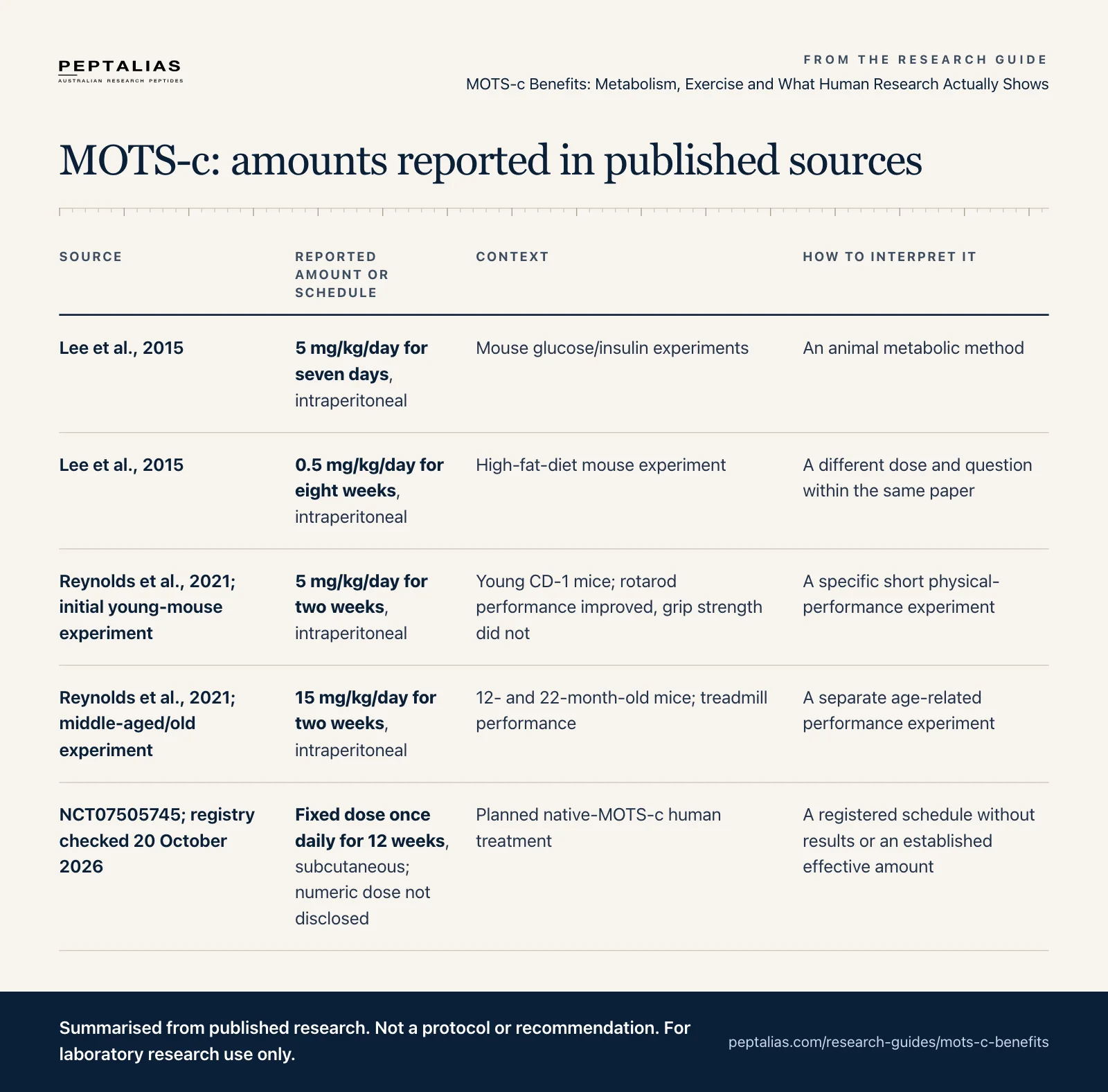
The animal methods are available in the 2015 full text and 2021 PDF. The registry supplies the human schedule.
A mouse mg/kg figure is mass per body weight within that experiment. Multiplying it by a person's weight would produce arithmetic, not a validated human protocol. A research vial's labelled milligrams similarly describe nominal supplied quantity, not a recommended dose or course length.
The fact that the studies used different amounts is informative. There is no scientific reason to average an eight-week diet experiment and a short physical-performance experiment into a single general “MOTS-c protocol”. The source should keep the amount, model and endpoint attached.
What human treatment research is under way?
The official record for NCT07505745, sponsored by Hudson Biotech, describes a phase 2a trial of native MOTS-c in an estimated 120 adults with prediabetes and overweight or obesity. It is randomised and placebo-controlled, with subcutaneous administration and lifestyle counselling in both groups. Its primary outcomes include insulin sensitivity by the Matsuda Index at 12 weeks and treatment-emergent adverse events over 16 weeks. Registry.
When checked on 20 October 2026, the record displayed recruiting, with no posted results; its latest posted update was 1 April 2026. Recruitment status is sponsor-reported and should be rechecked before publication. Estimated enrolment is not confirmation that 120 people have completed treatment.
The absence of a disclosed numeric dose should stay visible. Filling it with a mouse conversion or a clinic convention would make the article appear more complete by inventing a connection that the record does not provide.
CB4211 is a modified analog, not native MOTS-c
The completed NCT03998514 study enrolled 88 participants across its phase 1a/1b programme in healthy volunteers and people with fatty liver disease. Its intervention was CB4211. The registry displayed completion in April 2021 and no posted results when checked.
CohBar's own 2021 announcement explicitly identifies CB4211 as a modified MOTS-c analog and describes company-reported biomarker findings. That is a genuine drug-development source, but its result belongs to CB4211.
The identity distinction prevents two errors: calling the analog programme a completed trial of native MOTS-c, and transferring its amount or reported response to a native-MOTS-c research product. Similarity is a reason to investigate, rather than proof of interchangeability.
Frequently asked questions
What does MOTS-c do?
It is studied as a mitochondrial-derived metabolic signal. The central evidence concerns cellular energy-response pathways, glucose handling and physical performance, with administered-peptide findings mainly in animals.
Is MOTS-c proven for fat loss?
It has reduced diet-associated weight gain in mouse experiments. The reviewed sources do not establish a reliable human fat-loss effect from native MOTS-c, and the registered human trial has no posted results.
Is it an exercise substitute?
That has not been established. Exercise raising the body's own MOTS-c is different from a trial showing that administered MOTS-c reproduces exercise benefits.
How long does MOTS-c take to work?
There is no established human onset or cycle for a particular benefit. Animal assessment days and the registered human study's 12-week schedule are research timepoints, rather than promises of a personal response.
How should I compare a research material with a study?
Start with identity: native MOTS-c or an analog, the formulation, the route and the measured endpoint. The MOTS-c product page supplies material information, while the laboratory-report guide explains documentation checks. Analytical identity and purity do not independently demonstrate the metabolic or exercise benefit being investigated.